
Swedish names work differently from those of most of the English-speaking world, and understanding the conventions is essential—not just interesting—for research. The patronymic system in particular, where the surname changed every generation, trips up newcomers constantly, and a few other features (women keeping their own names, soldier names, farm names) can confuse the unprepared. This guide explains how Swedish names worked, so you can recognise your family in the records and avoid the common pitfalls.
The patronymic system
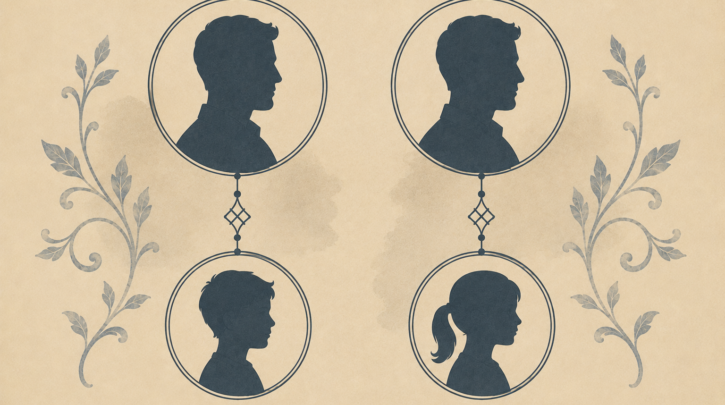
The defining feature of historical Swedish names is the patronymic: a person’s surname was formed from their father’s given name. The son of a man named Anders was Andersson (“Anders’s son”); his daughter was Andersdotter (“Anders’s daughter”). This means the surname changed every generation: Anders Svensson’s son Erik would be Erik Andersson, and Erik’s son Per would be Per Eriksson. For the researcher, this is the single most important thing to internalise—you cannot follow a Swedish family by surname, because the surname is not hereditary; you follow it by given names, parents and parish.
Not sure where to start with your Swedish ancestry?
Get the Swedish Genealogy Quick-Start Checklist — a 5-step path to your first real ancestor record, plus the household examination rolls that make this research unusually detailed.
Women kept their own names
A feature that surprises many: traditionally, Swedish women did not take their husband’s name on marriage. A woman born Maria Andersdotter remained Maria Andersdotter all her life, even after marrying Erik Eriksson. This is a great help in research, because you can follow a woman by her own patronymic throughout her life and identify her in the records by it—a real advantage for tracing the maternal lines, and quite different from the practice in many other countries.
Soldier names
One distinctive category deserves attention. Under Sweden’s old military allotment system, soldiers were commonly given a short, distinctive soldier name (soldatnamn) to tell apart the many men with patronymic surnames in a regiment—names like Modig (“brave”), Rask (“quick”), Stark (“strong”) or names tied to the soldier’s croft. A man might be Anders Svensson in civilian life and take a soldier name on enlisting, then perhaps revert or pass the name on. If a soldier name appears—or disappears—in your line, it can look like a confusing break, so it is worth knowing about; we cover it further in our surname guide.
Farm names
In some regions—Dalarna especially—families used farm names (gårdsnamn), placed before the given name and tied to the farm where the family lived. A person might be recorded with a farm-name prefix that changed if the family moved to a different farm, which can again look puzzling. Regional naming customs like this are worth being aware of, because they explain names that do not fit the simple patronymic pattern.
Understanding names is what lets you actually find your family. Pair this with reading old Swedish records, and search the free registers on the records hub.
The shift to fixed surnames
The patronymic system gave way to fixed, hereditary surnames around the turn of the twentieth century, formalised by the Names Adoption Act of 1901, after which families kept a permanent surname. Many simply froze a patronymic—which is why Sweden is full of inherited -son surnames like Andersson, Johansson and Karlsson today—while others adopted new family names. The story of how Swedish surnames became fixed, and what they mean, is told in our guide to Swedish surname origins. For research before about 1900, though, the rule is the patronymic one: follow given names, parents and parish, never the surname alone.
Why naming is the key research skill
Understanding Swedish naming is not background colour; it directly determines whether you can find your family. Because the patronymic changed every generation, a researcher who tries to follow a constant surname will fail almost immediately—the thread to grasp is not the surname but the chain of given names linked through parents and parish. Internalising this changes how you search: you look for a person of the right given name, with the right father’s name embedded in their patronymic, in the right parish, at the right time, and you confirm them through the family group rather than the surname. Once this clicks, the patronymic system stops being a confusion and becomes a logical, followable pattern.
The other conventions reinforce the point. Because women kept their own patronymics, you can trace maternal lines with a clarity many genealogies lack—a great advantage. Because soldier names and farm names could attach to or detach from a person, you learn not to be thrown when a name appears or vanishes, but to look for the same individual beneath the changing label. Each convention, once understood, turns from a trap into a tool, and together they make the apparently bewildering Swedish name system into something you can navigate with confidence.
Patronymics and the records
In the records, the patronymic system meshes neatly with the household examination books, which list each person with their patronymic alongside their birth data and parents—so you can see, in one place, that this Erik Andersson is the son of Anders Eriksson, distinguishing him from every other Erik Andersson in the parish. This is why reconstructing the full family group is the answer to patronymic confusion, and why the household examination records are so central. Master the naming conventions and the records together, and the most distinctive feature of Swedish genealogy—the ever-changing surname—becomes simply the way the system works, navigable and even elegant once understood.