
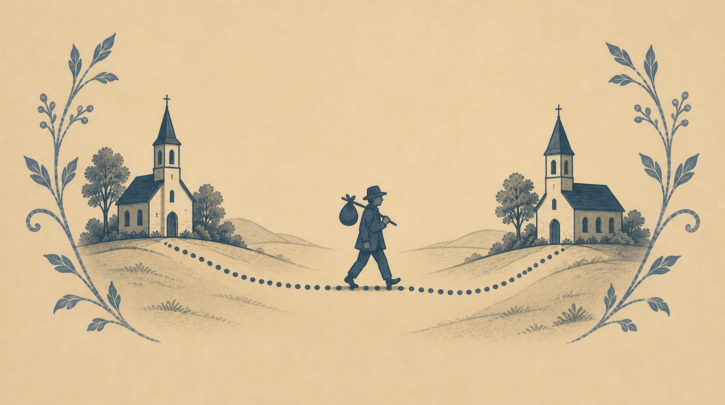

Swedes moved—between farms, between parishes, across the country in search of work and land—far more than many people expect, and following a family through those moves is one of the central skills of Swedish genealogy. Fortunately, the Church of Sweden recorded the movements, in the moving records (in- och utflyttningslängder). Understanding them is what lets you keep hold of a family that does not stay conveniently in one parish. This guide explains how they work.
How the system worked
When a person moved from one parish to another, the church documented it twice. The parish they left recorded their departure in the out-moving record (utflyttningslängd), and the parish they joined recorded their arrival in the in-moving record (inflyttningslängd). The mover typically carried a moving certificate (flyttningsbetyg or prästbevis)—a kind of reference from the old priest to the new—noting their identity, conduct and religious knowledge. For the genealogist, these paired records are a tracking device: the out-record tells you where someone went, and the in-record tells you where they came from.
Not sure where to start with your Swedish ancestry?
Get the Swedish Genealogy Quick-Start Checklist — a 5-step path to your first real ancestor record, plus the household examination rolls that make this research unusually detailed.
Why they matter so much
Moving records solve the most common practical problem in Swedish research: an ancestor who vanishes from one parish’s books. Rather than a dead end, a disappearance is usually just a move, and the moving record—or the corresponding note in the household examination record—tells you which parish to look in next. By following the chain of moves, you can trace a mobile family across several parishes and keep the line unbroken, where without the moving records you would simply lose them.
Moving records, like all the church books, are free at Riksarkivet and clearest on ArkivDigital. See both on the records hub.
Using them with the household examination records
In practice, the moving records and the household examination records work hand in hand. The household examination book usually notes, in its columns, the year a person moved in and out and the parish concerned—so often you can follow the moves directly from the husförhörslängd without even consulting the separate moving lists. When the household examination note is unclear or missing, the dedicated in- and utflyttningslängder fill the gap. Together they form a continuous trail you can follow parish to parish, which is exactly how a well-traced Swedish line is built.
A few practical tips
Moving records reward a methodical approach. Note the date and the named parish precisely, since that is your pointer to the next record; watch for moves that cross into a different county or province, which widen the search; and remember that young people moved frequently for work (as farmhands and maids), so an unmarried ancestor may have several moves in a few years. As always, the old handwriting takes a little practice, but the format is consistent and quickly becomes familiar.
Keeping the thread
Mastering the moving records is what separates a Swedish family tree that stalls at the first relocation from one that follows the family wherever they went. Because Swedes were mobile, and because the church diligently recorded every move, you have both the challenge and its solution built into the same record system. Follow the moves carefully, parish by parish, and you can trace a Swedish family across a lifetime of relocations—and back, generation by generation, toward the parishes where the line began.
Why Swedes moved so much
It surprises many researchers how mobile the Swedish population was, but there were good reasons. Unmarried young people commonly worked as farmhands (drängar) and maids (pigor) on other farms, often moving annually around the autumn hiring period, so a single young ancestor might appear in several parishes within a few years. Families moved in search of land or work, crofters and labourers relocated as circumstances changed, and the landless rural population in particular was far from static. The result is that following the moves is not an occasional task but a routine part of Swedish research—and the church’s diligent recording of every move is what makes it possible.
Understanding this mobility also helps you interpret what you find. A cluster of moves in a young person’s record usually marks years in service rather than anything unusual; a family’s move may coincide with a change in fortune recorded elsewhere; and the destinations of moves trace the social and economic currents of rural Sweden. Far from being mere administrative notes, the moving records sketch the real, mobile lives your ancestors led, and reading them with that understanding turns a tracking exercise into a richer picture of the family.
Following a move step by step
The method for following a move is simple and reliable. When the household examination record or a moving list shows an ancestor leaving for a named parish, go to that parish’s in-moving record and household examination book for the year, and find them arriving—the details should match, confirming the link. Then continue from there. If a move is to an unstated or unclear destination, the dedicated utflyttningslängd may give what the household book omits, and neighbouring parishes are worth checking for a short-distance move. Followed patiently, the chain of moves keeps your family’s line unbroken across every relocation, all the way back toward the parish where it began.