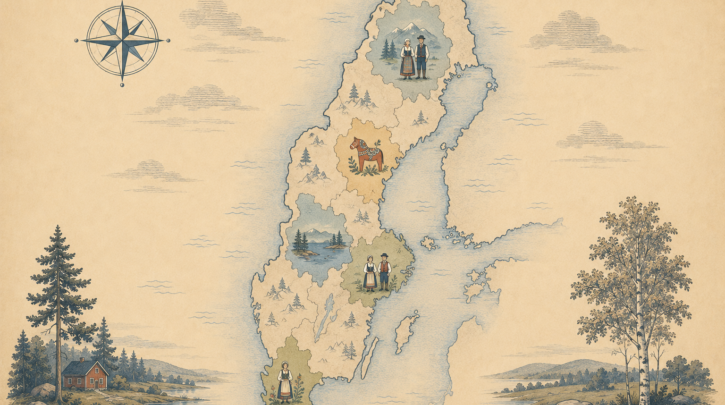

To understand where your Swedish family came from is to understand a province—a landskap—because Sweden’s historic provinces each have a strong and distinct identity, with their own landscape, dialect, folk costume, traditions and character. Your ancestral parish sits within one of them, and knowing your province deepens your sense of your heritage immeasurably. This guide introduces the Swedish provinces and what they mean for your family story.
Why the provinces matter
Though Sweden is one country, its provinces retain identities older than the modern nation, and Swedes still feel a strong attachment to their landskap. Each has its own traditions, its own folk costume (folkdräkt), often its own dialect, and a distinct landscape—from the lakes and forests of the interior to the southern plains and the far northern wilderness. For the family historian, learning your province turns a vague “Swedish” heritage into something specific and rooted: not just Swedish, but Smålandish, or from Dalarna, or from Skåne, each with its own flavour.
Not sure where to start with your Swedish ancestry?
Get the Swedish Genealogy Quick-Start Checklist — a 5-step path to your first real ancestor record, plus the household examination rolls that make this research unusually detailed.
Some of the provinces you may trace to
Your roots may lead to any of Sweden’s provinces, but a few recur often in family histories and reward knowing:
- Dalarna — the romantic heartland of Swedish folk culture, home of the painted Dala horse, vivid folk costumes, and beloved Midsummer traditions; an iconic image of “old Sweden.”
- Småland — a stony, forested southern province whose poor soil helped drive the great migration; the emigration heartland, and home to the glass country (Glasriket).
- Skåne — the fertile far south, historically Danish until the 1600s, with its own dialect and a distinct, continental character.
- Hälsingland — known for its richly decorated farmhouses; Värmland for its forests and folklore; Lapland and the north for the Sami and the wilderness.
Småland and the emigration story
For Swedish-American families especially, one province carries particular weight. Småland, with its thin, stony soil and hard farming, sent enormous numbers of emigrants to America, and it is the spiritual home of the Swedish emigration story. The House of Emigrants (Utvandrarnas Hus) in Växjö, in Småland, is a museum and research centre devoted to the great migration—a moving place of pilgrimage for descendants, and a practical resource for tracing an emigrant ancestor. If your family left from Småland, a visit there connects your emigration history to the very ground it sprang from.
Knowing your province starts with knowing your parish. Find it with the free records, then explore the region on your heritage trip.
The threads of Swedish culture
Across the provinces, certain threads run through Swedish heritage everywhere. The food—meatballs and lingonberry, pickled herring, crispbread, the coffee-and-cake ritual of fika. The traditions—the maypole and flower crowns of Midsummer, the candlelit Lucia procession in December, crayfish parties in late summer. The folk culture—the music, the dances, the costumes that vary by province. And the landscape itself, with the right to roam that lets every Swede feel at home in nature. These are shared across the Swedish world, given local colour by each province.
Bringing regional heritage home
You do not have to travel to begin reclaiming your regional heritage—though it helps. Learn the history and character of your particular province; cook its and Sweden’s dishes; learn about its folk traditions, its dialect and its costume; understand the landscape and the forces—like Småland’s poor soil—that shaped your ancestors’ lives and sometimes their departure. Each of these turns a vague Swedishness into a specific, rooted identity. It is part of the larger work of reclaiming your heritage—and it begins, as always, with knowing precisely which parish and province your family came from.
Finding your specific regional identity
The practical task for the family historian is to move from the generic to the specific—from “Swedish” to the actual province your family belonged to. This is one more reason the genealogical groundwork matters so much: only by identifying your parish do you learn which provincial heritage is truly yours, with its particular landscape, dialect, traditions and history. A family that always called itself simply “Swedish” may discover it is specifically from Småland, with that province’s emigration story written into its past, or from Dalarna, with its rich folk culture—and that discovery makes the heritage real and rooted rather than abstract.
Once you know the province, a world of specific heritage opens. You can learn its history as a distinct place, understand the forces that shaped your ancestors’ lives there—the poor soil that drove emigration from Småland, the mining and forests of other regions—and connect with its living traditions and, sometimes, the relatives who remain. The regional lens transforms a vague ancestral fondness into the specific, living inheritance of a particular corner of Sweden, and it gives a heritage trip its shape and meaning.
The provinces and the emigration
There is a poignant connection between the provinces and the great migration worth drawing out. Emigration was not evenly spread across Sweden; some provinces—Småland above all, with its hard farming—sent disproportionate numbers to America, while others lost fewer. Recognising your province therefore often illuminates why your family left: the specific local conditions, the poverty of a stony parish, the chain of neighbours already gone before them. And it connects the two halves of the story—the Swedish province they came from and the American settlement they built—into one continuous thread, traceable from a Midwest community back to a particular landskap and parish. For the descendant, understanding the province is understanding both the home that was left and the reasons for leaving it.