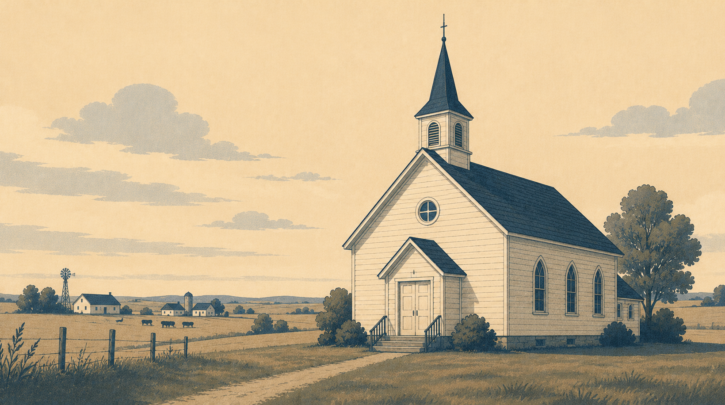

When Swedish immigrants built new lives in America, the church was often the first institution they founded and the centre of community life. For the genealogist, these Swedish-American churches are doubly important: they anchored the communities where your ancestors lived, and their records—sometimes naming the Swedish parish of origin—can be the very link you need to cross back to Sweden. This guide explains the main churches and how to use their records.
The Augustana Lutheran Synod
The largest and most important Swedish-American religious body was the Augustana Evangelical Lutheran Synod, founded in 1860. Rooted in the Lutheran faith of the Church of Sweden that most emigrants had belonged to, Augustana congregations sprang up across the Swedish Midwest and beyond, conducting services in Swedish for decades and serving as the spiritual and social heart of countless communities. For families of Lutheran background—the majority—the records of an Augustana congregation are often the first place to look for the immigrant generation.
Not sure where to start with your Swedish ancestry?
Get the Swedish Genealogy Quick-Start Checklist — a 5-step path to your first real ancestor record, plus the household examination rolls that make this research unusually detailed.
Other Swedish-American churches
Not all Swedish immigrants were Augustana Lutherans, and several other traditions flourished:
- The Mission Covenant (the Evangelical Covenant Church) — a free-church movement strong among Swedish Americans, born from the revivalist “Mission Friends.”
- Swedish Methodists and Swedish Baptists — smaller but significant communities with their own congregations and records.
- Other free churches — reflecting the religious dissent that had helped drive some emigration in the first place.
Knowing which tradition your family followed helps you find the right congregation and its records.
Why the records matter for genealogy
Swedish-American church records can be a genealogical bridge across the Atlantic. Congregational registers of baptisms, marriages, deaths and membership—and especially records of members received from Sweden—sometimes name the immigrant’s Swedish birth parish, which is precisely the fact you need to continue your research in Sweden. Even where they do not name the parish, they document the immigrant generation, confirm family relationships, and place your ancestor within a community whose other members’ origins may point to your own.
A church record that names the Swedish parish is the key across the ocean. Learn to use it with the emigration records in finding your Swedish emigrant ancestor, then trace deep on the records hub.
Finding the records
To use these records, first identify the congregation your ancestor belonged to—clues come from where they settled, family memory, and obituaries or other records mentioning a church. Many Swedish-American church records have been preserved in denominational and college archives (the Augustana tradition, for example, is associated with institutions that hold historical records) and some are digitised or indexed. Local historical societies and the surviving congregations themselves can also help. Once located, the registers may give you not just your family’s American chapter but the name of the parish that opens their Swedish past.
The church as community
Beyond their records, the Swedish-American churches are central to understanding your ancestors’ lives. For immigrants far from home, the congregation preserved the language, the faith and the festivals of Sweden, eased the hardships of settlement, and bound the community together—often clustering, through chain migration, families from the same Swedish districts. To find your family in a Swedish-American church is to find them within that world, and frequently to find, in the register’s pages, the thread that leads back across the sea to the parish they came from.
The church at the centre of immigrant life
To appreciate why these records are so rich, it helps to understand how central the church was to immigrant life. For Swedish settlers—often isolated on the prairie or newly arrived in a city, far from family and homeland—the congregation was far more than a place of Sunday worship. It was the institution that married them, baptised their children and buried their dead; that preserved the Swedish language and the familiar Lutheran forms; that provided fellowship, mutual aid and a sense of continuity with the world they had left. People organised a congregation early, sometimes before they had much else, and its life touched nearly every member of the community.
Because the church was so central, its records are correspondingly complete and revealing—documenting not just isolated events but the whole arc of members’ lives and their movements into and out of the community. For the genealogist, this means a Swedish-American congregation’s registers can reconstruct a family’s American chapter in detail and, through records of members received from Sweden or transferred between congregations, trace their movements and sometimes name their Swedish parish of origin.
Tracing a congregation over time
Congregations changed over the generations, and following those changes helps you locate the records. A church founded as a Swedish-speaking Augustana or Mission congregation may, with assimilation, have shifted to English services, merged with other congregations, changed its denominational affiliation, or eventually closed—its records passing to a successor church, a denominational archive, or a historical society. Tracing this institutional history is sometimes necessary to find where the old registers ended up. The effort is worthwhile: those registers, kept by a church at the heart of your ancestors’ community, are among the most valuable Swedish-American sources, and a leading candidate to hold the parish name that carries your research back across the sea.