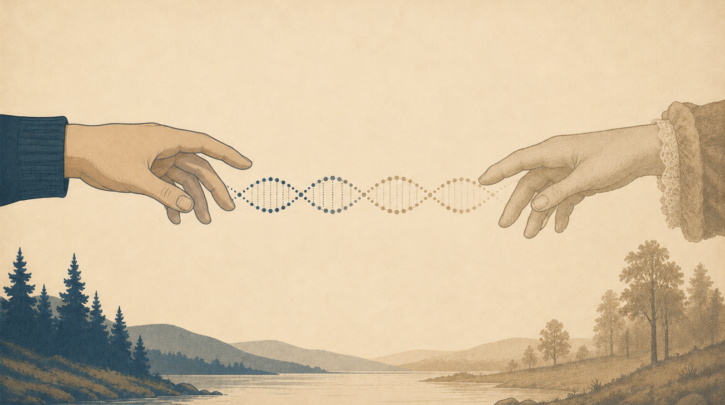

A DNA test is at its most rewarding when it stops being a list of strangers and becomes a way to meet real relatives — the cousin in Sweden with the family photographs, the distant relation in Minnesota who already traced the line you are stuck on. Most of the workflow is the same as for any DNA research. But a few complications come up again and again in Swedish family history specifically, and they trip people up because they are not the kind of thing a generic DNA guide warns you about. This is a Q&A on the three that matter most: fostering that the records never labelled, a surname that changed the moment an ancestor boarded a ship, and how to actually write to a cousin you have never met in Sweden.
When adoption or fostering doesn’t show up in the records
Modern legal adoption is a recent invention in Sweden, which means a lot of nineteenth-century family restructuring happened in ways the standard church and household records were never built to flag clearly.
Not sure where to start with your Swedish ancestry?
Get the Swedish Genealogy Quick-Start Checklist — a 5-step path to your first real ancestor record, plus the household examination rolls that make this research unusually detailed.
My DNA match doesn’t fit any documented relationship. Could an ancestor have been informally fostered?
Yes, and this is worth taking seriously before you assume an error in your research. Sweden did not have a formal adoption law until 1917. Before that, what existed instead was informal fosterbarn (foster child) arrangements, loosely governed by an 1833 servant statute that gave a family taking in a poor, parentless child roughly the same authority and responsibility over that child as over their own — but it created no new legal parentage, and before 1903 there was essentially no official oversight of these placements at all. A child raised this way might appear in the household examination rolls simply listed within the household, sometimes without any note distinguishing them from a biological child. If a DNA match shares DNA at a level that doesn’t match the documented family structure, an unrecorded fostering arrangement, or an unacknowledged biological parent behind one, is a genuinely common explanation, not a far-fetched one.
What about children born outside marriage — did their surname reflect who actually raised them?
Often, yes, and this is a related trap. Historically, a child born outside marriage was not automatically recorded with the biological father’s name. Depending on the situation, the child might be recorded with the father’s name and a patronymic ending, the mother’s given name with -dotter or -son attached, the name of a stepfather if the mother later married, or even a grandfather’s name if the child was raised by grandparents. Combined with Sweden’s patronymic system, this means the surname recorded for a child can reflect their household situation at a given moment far more than it reflects strict biology — exactly the kind of gap a DNA match can expose that a documents-only search would never catch.
Where do I actually look if I suspect a fostering situation?
- Re-read the household examination roll entry carefully for the child in question — foster children were sometimes, though not always, noted distinctly from biological children.
- If the placement happened through a city, check whether that city had a children’s home (barnhus) — Stockholm, Gothenburg, Lidköping, Malmö, and Uddevalla all had one, and orphanage archives are often preserved separately from parish records.
- For placements after 1903, look for municipal (kommunarkiv) child-welfare board records rather than church archives, since oversight of foster children shifted to secular authorities around that date.
- Treat a DNA-confirmed biological relationship as the fact, and the documented household relationship as context — both are part of the real story, and neither should be quietly erased in favor of the other.
Surname changes at the point of emigration
My closest DNA match has a completely different surname than my Swedish ancestor. Could we still be related?
Absolutely, and for Swedish research this is common enough that it should be your default assumption rather than a surprise. As covered in how Swedish names changed in America, surnames drifted substantially after emigration — not usually through a single dramatic change at the port of arrival, but gradually, as families simplified spelling, dropped diacritics, or Americanised a name for convenience over the following years. A match descended from the same Swedish family as you may carry a surname that looks nothing like the one in your Swedish-side records, purely because their branch anglicised differently, or at a different point, than yours did.
How do I recognize a match’s surname as a variant of my own Swedish line?
- Compare the match’s surname phonetically, not just visually — Andersson/Anderson, Sköld/Skold/Shold, and Björk/Beork are the same name pronounced and then respelled.
- Look for a frozen patronymic on one side and a modern hereditary surname on the other — a match’s “Peterson” may descend from an ancestor recorded in Sweden as “Petersson” or even from a patronymic that only froze into a surname after 1901.
- Weight shared places far more heavily than shared surnames. A match whose tree points to the same Swedish parish or province as yours is a strong lead regardless of what surname they currently carry; a match who merely shares a common -son surname with no shared place is not.
Should I ignore surname entirely when reviewing matches?
Not entirely — a surname can still be a useful confirming detail once a relationship is otherwise likely, and an unusual, less common surname carrying through cleanly is a genuinely strong signal. The point is not to rule a match out just because the surname looks unrelated at first glance, and not to rule one in just because it shares a common patronymic ending with half the country. Treat the surname as one clue among several, and let shared places and shared matches do most of the real work.
Etiquette for reaching out to a living cousin in Sweden
What should a first message to a Swedish DNA match actually say?
The same principles that make any first DNA message effective apply, with a light Swedish inflection. Be specific — name the likely shared ancestor, parish, or province rather than sending a generic “we match!” note. Offer before you ask: share a document, a photo, or what you already know, rather than leading with a request. Keep it short and warm, and be patient — many testers, in Sweden as everywhere, are not active genealogists and may take weeks to notice a message at all.
Will a Swedish cousin respond differently than an American one?
Sometimes, in tone more than substance. Swedish culture tends to value modesty and understatement — often summarised as lagom, roughly “just the right amount,” and a related reluctance toward self-promotion sometimes called Jantelagen. A Swedish cousin’s reply may read as more measured or reserved than an enthusiastic American cousin’s might, without that reflecting any real difference in interest. Give a quieter reply the same benefit of the doubt you would give an enthusiastic one, and let the relationship warm up at its own pace.
Should I write in Swedish or English?
English is a safe and genuinely welcome choice. Swedes generally speak excellent English, and a message in clear English is very unlikely to be a barrier. That said, opening with a short line in Swedish — even a simple “Hej, jag tror att vi är släkt” (“Hi, I think we’re related”) before switching to English for the substance — is a small gesture that is almost always appreciated, and signals that you have made a genuine effort to connect with their side of the family, not just mined their DNA data.
What if they never reply?
Expect this to happen more often than not, and do not take it personally. Many people test out of curiosity about ethnicity and never return to the platform; others are private, busy, or simply overwhelmed by the volume of match requests a popular surname or region can generate. Send a good, specific, low-pressure message, then move on to your next promising match rather than waiting on any single reply. The cousins who do engage — especially those who already know their ancestral parish — are consistently the most generous collaborators you will find anywhere in Swedish research, and worth the patience the process requires.
Beyond these three questions: the core workflow
These complications sit on top of, not instead of, the basic DNA-matching workflow. Test where your relatives actually are — AncestryDNA for diaspora cousins, MyHeritage for its Nordic strength, ideally both via a free upload, all covered on the DNA hub. Triage your match list from closest to most distant, use shared-match clustering to identify which matches descend from the same branch, and once you have a real hypothesis, confirm it in the household examination records and church books before it goes into your tree as fact. The full method is in connecting DNA to Swedish records.
The special prize: a cousin still in Sweden
For Swedish researchers, a match worth hoping for is the relative who never emigrated — a cousin whose family stayed in Sweden, perhaps still near the ancestral parish. Such a match can do what no record search can: tell you the parish outright, share family history the emigrant branch lost touch with a century ago, and connect you with relatives still living where your ancestors did. Reaching out warmly and specifically, with the etiquette above in mind, is one of the most rewarding messages you will send in the whole course of your Swedish research — and the one most likely to break a stubborn parish-of-origin wall for good.