
For Swedish emigrants bound for America, the long journey ended at an American port—for many, the immigration station at Ellis Island in New York. Around that arrival cluster some of the most useful records in Swedish-American genealogy, and also one of its most persistent myths: the belief that names were changed by officials on arrival. Understanding what really happened, both to the records and to the names, is important for tracing your family. This guide sorts fact from legend.
Castle Garden and Ellis Island
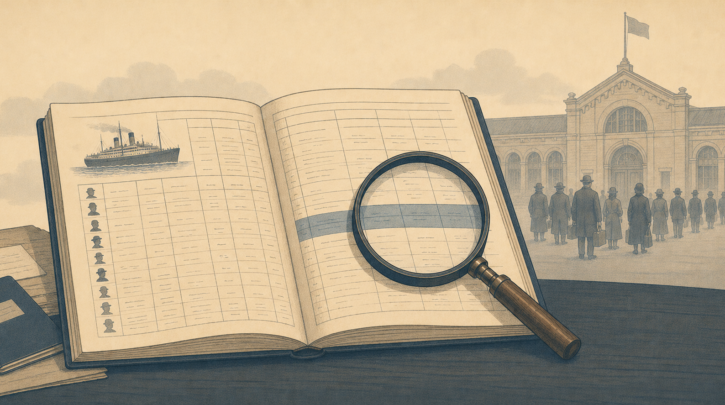
New York was the main port of arrival for Swedish immigrants, and the reception point changed over time. Before 1892, immigrants arriving at New York were processed at Castle Garden; from 1892, the famous Ellis Island station took over. At both, arriving passengers were recorded, and the passenger arrival lists created in the process are a valuable genealogical source—potentially naming your ancestor, their age, origin and destination. Many Swedes arrived at New York, though some came through other ports, so it is worth checking arrival records broadly.
Not sure where to start with your Swedish ancestry?
Get the Swedish Genealogy Quick-Start Checklist — a 5-step path to your first real ancestor record, plus the household examination rolls that make this research unusually detailed.
The name-change myth
Now the myth. A enduring family story holds that an official at Ellis Island arbitrarily changed the immigrant’s name—shortening, “Americanising” or misspelling it on the spot. In fact, this is not how it worked. Immigration officials at Ellis Island processed arrivals using the passenger lists created at the port of departure; they did not assign new names. The names on the arrival records reflect what was written when the emigrant left Europe, not an official’s invention on arrival.
Why this matters for research: because names were not changed at Ellis Island, the arrival record generally preserves the name your ancestor travelled under—close to its original Swedish form. Name changes happened later and voluntarily, as immigrants and their children adapted their names to American life. So the arrival and departure records are valuable precisely because they predate that change.
How Swedish names really changed
Swedish names did change in America—but gradually, by the immigrants’ own hand, as part of assimilation. The patterns are recognisable and help you reverse them:
- Frozen and simplified patronymics — a patronymic like Andersson became a fixed surname and was simplified, often by dropping an s: Andersson to Anderson, Johansson to Johnson, Nilsson to Nelson, Eriksson to Erickson or Erikson.
- Dropped Swedish letters — the letters å, ä and ö were rewritten (å/ä to a, ö to o), reshaping a name’s spelling.
- Anglicised given names — Sven became Swan or Swen, Erik became Eric, Johan became John, Anders became Andrew.
- Adopted family names — some who had used patronymics took an entirely new fixed surname in America.
To find your family in Sweden, recover the original name and parish from the arrival and emigration records. The method is in finding your Swedish emigrant ancestor; the records are on the records hub.
Using arrival records well
For the genealogist, the practical lesson is to treat the arrival and departure records as preserving the original name, and to work backward from the anglicised American form to that original. Reverse the common changes—restore the dropped s, the Swedish letters, the patronymic—and sound the name out, and the Swedish original usually emerges. Paired with the Gothenburg records and the emigration databases, the arrival record helps confirm your ancestor and recover the name and parish you need to cross back into the Swedish records. The myth, once set aside, gives way to a clear and useful body of evidence.
Reading the passenger lists
The passenger arrival lists repay close attention, because over time they grew more detailed and can carry exactly the clues you need. Later lists, in particular, may record an immigrant’s last residence or birthplace, the name and address of a relative left behind in Sweden, and the name and address of the person they were joining in America—each a potential lead to the home parish or to other family members. Reading every column, not just the name, can turn a simple arrival record into a rich source that points both backward to Sweden and forward into the immigrant’s American network.
These lists also help confirm an identification. When an arrival record’s details—age, origin, travelling companions, destination—align with what you know of your ancestor and with the departure records, you can be confident you have the right person, and the name as recorded gives you the form closest to the Swedish original. Paired with the emigration databases, the arrival list is a key piece of the triangulation that fixes your ancestor’s identity and origin.
Recovering the original name
Because the arrival and departure records preserve the name your ancestor travelled under—before the gradual American assimilation that reshaped it—they are central to recovering the Swedish original you need for further research. Work backward from the modern American spelling: restore a dropped s to a frozen patronymic, return anglicised given names to their Swedish forms, and reinstate the Swedish letters. Then check the result against the emigration and parish records. The arrival record, far from being the moment a name was changed, is often the very document that lets you change it back—and so reopens the path to the parish and the deep Swedish past.