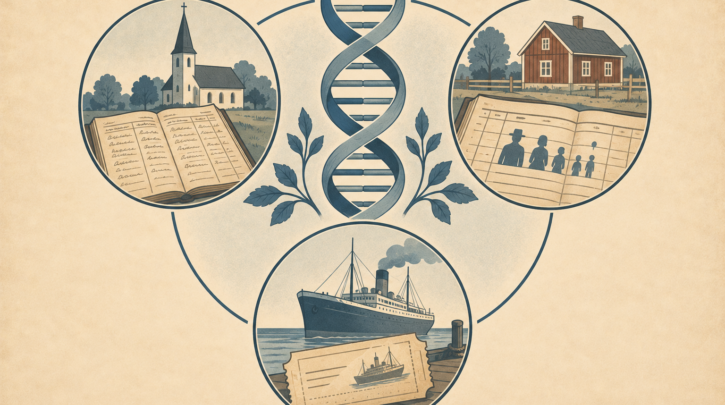

A DNA match is a clue, not a conclusion. The work that turns it into genuine genealogy is anchoring it in documents — but not every Swedish record type answers the same question. A parish baptism entry, a household examination roll, and a departure record from Gothenburg each confirm (or rule out) something different about a hypothesized relationship, and using the wrong one for the job is a common way researchers convince themselves of a connection the records do not actually support. This guide breaks down exactly which Swedish record type proves what, so you can verify a match with the right tool instead of the first one that turns up.
Why records, not centimorgans, settle it
Shared DNA tells you that you are related, not precisely how. The only thing that establishes the specific relationship is a documented descent on both sides to a common ancestor. For most Swedish lines this is wonderfully achievable — the household examination records and church books are there to do it, and because Sweden is not strongly endogamous, the shared-DNA amounts are generally a reliable guide to the closeness of the relationship rather than a source of confusion.
Not sure where to start with your Swedish ancestry?
Get the Swedish Genealogy Quick-Start Checklist — a 5-step path to your first real ancestor record, plus the household examination rolls that make this research unusually detailed.
Which record actually proves what
Each of the three main Swedish record types was created for a different purpose, and each is strong at confirming or ruling out a different part of a DNA hypothesis. Here is what to reach for, and why.
| Record type | Best for confirming | Best for ruling out | Where it falls short |
|---|---|---|---|
| Church books (kyrkoböcker) | Exact birth/baptism dates with named parents; marriages linking two specific families; precise death dates | A hypothesis where the generation spacing implied by your shared-DNA amount doesn’t match the recorded birth years | Doesn’t show household context, so it can’t by itself tell two same-named men in neighboring parishes apart |
| Household examination rolls (husförhörslängder) | Full sibling groups and household composition at a point in time; a family’s movement between parishes | A candidate ancestor whose documented children don’t match the sibling set your match’s line requires | Ages are approximate, not exact, and rolls were only updated periodically, leaving gaps between compilations |
| Emigration records (Gothenburg departures, moving-out records, passenger lists) | Which specific person, among several same-named candidates, actually emigrated; family or sibling groups who travelled together | A hypothesized emigrant whose recorded age or travelling party doesn’t match your American-side match | Says nothing about ancestors further back in Sweden; still needs cross-referencing to the home parish |
Church books: pinning down the exact relationship
Church books are Sweden’s sacramental records — baptisms, marriages, and burials — recorded at the moment of the event by the parish priest. Their strength for DNA verification is precision: a baptism entry names both parents, giving you a confirmed parent-child link rather than an inference, and a marriage entry confirms exactly which two families were joined. This precision is what lets you check a DNA hypothesis against the calendar. If your shared-DNA amount with a match implies you are third cousins, but the church books show the common ancestor you have proposed was born only eight years before their supposed grandchild, something in the hypothesis is wrong — a generation has likely been skipped, or the wrong candidate has been chosen entirely.
What church books cannot do alone is place a person in context. A baptism record confirms a birth happened and names the parents, but it will not tell you whether that child had six siblings who also survived to adulthood, or whether the family later moved to a different parish entirely — for that, you need the household rolls.
Household examination rolls: seeing the whole family together
The husförhörslängder are Sweden’s parish-level household rolls, recording every person in a household together, updated periodically over the years. Where church books give you a single precise event, household rolls give you the whole picture at a point in time — every sibling, in one place, alongside their parents. This is exactly what you need to rule a candidate ancestor in or out when a DNA hypothesis depends on a specific sibling relationship: if your match’s tree claims their ancestor was a sibling of yours, the household roll should show both children in the same household under the same parents. If it does not, the hypothesis needs to be reconsidered.
Household rolls also earn their keep by tracking movement. Because they were updated as families moved between parishes, they can bridge a gap that church books alone would leave open — showing a family relocating from an interior parish toward a coastal one in the years before emigration, for instance, which can be the missing link between a documented Swedish family and the departure records covered below.
Emigration records: the bridge a DNA match actually needs
For a Swedish-American DNA match, the hardest part of verification is rarely the Swedish side or the American side alone — it is proving the two are the same person. This is where emigration records earn their specific place: Gothenburg departure records, moving-out attestations, and passenger manifests can confirm that a specific, documented individual — not just someone with the same name — actually left a specific parish on a specific date, often travelling with named family members. When several matches on the American side all descend from people who left together as a documented group, that travelling party is strong evidence the DNA relationship and the paper trail are describing the same family.
Emigration records are also the best tool for ruling out a tempting but wrong candidate. A common name like Anders Andersson might have several men emigrating from different Swedish parishes in the same decade; the recorded age, home parish, and travelling companions in the departure record let you check whether your specific candidate’s documented profile actually matches what your American-side match’s family history requires, rather than assuming a name match is enough.
Using all three together
In practice, a well-verified match usually draws on all three record types, each doing the job it is best at: church books for the precise generational math, household rolls for the sibling and family context, and emigration records for the transatlantic bridge. Treating any single record type as sufficient on its own is the most common way researchers end up confidently wrong.
The workflow, step by step
- Form a hypothesis. From shared matches, a shared parish or province, or a ThruLines/Theory suggestion, identify a candidate common ancestor or family.
- Document your own descent. Build your line down from that family to yourself, with a record for each link, in the church and household examination records.
- Document the match’s descent. Do the same for their line. Their tree is a starting point — confirm it in the records rather than trusting it.
- Mind the patronymics. Follow the changing patronymic chain, not a fixed surname, and never assume two same-named families are related.
- Cross the ocean deliberately. If the match is Swedish-American, don’t assume a name match bridges the Atlantic — confirm it with the specific emigration record, not just a shared surname.
- Record your evidence. For every link, note the record, date, parish and source.
When DNA helps find your parish
For Swedish research, DNA has one almost magical use: helping you find the parish of origin when the emigrant records never named it. If you cannot identify the parish, a cluster of DNA matches who do know their ancestral parish — or whose trees point to a specific Swedish parish or province — can break the wall. When several of your matches trace to the same area and connect through a shared line, that parish becomes your strong candidate to search. This is genetic genealogy at its best: not replacing the documents, but telling you which documents to go and find — and given how much Swedish material is free on Riksarkivet, you can usually go straight there and confirm.
The free Riksarkivet and FamilySearch records are the engine of this process. See access on the records hub, and find your matches first with our matching workflow.
A crucial limit: DNA and citizenship
If your interest in proving a line is Swedish citizenship, understand two things. First, as our citizenship guide explains honestly, most descendants of Swedish emigrants do not qualify for citizenship by descent at all, because the pre-2001 rules broke the chain. Second, even where a claim exists, DNA evidence carries no weight in it — Swedish citizenship turns on a documented chain of legal status, not on a match list or a shared-centimorgan total. DNA may help you find relationships and your parish, but it proves nothing for citizenship. This is informational only and not legal advice; verify any citizenship question with the Swedish Migration Agency.
A note on tree-sharing and accuracy
A DNA match’s own tree is a gift and a trap. It can save you hours by pointing toward the likely common ancestor, but online trees are riddled with copied errors, and a single wrong link can appear to be “confirmed” by DNA when the real connection runs through a different family. Treat every borrowed tree as a hypothesis: pull the actual records yourself from Riksarkivet and the church and household examination books, read them, and only then accept the link. The discipline is the difference between a tree that looks impressive online and one that is actually true — and it matters all the more in Swedish research, where frozen patronymics and ubiquitous -son names make false connections easy to fall into.
The honest bottom line
A Swedish tree built by matching the right record to the right question is something rare and durable: a family history both genetically and documentarily proven, resistant to the pitfalls that mislead automated tools. Church books settle the dates, household rolls settle the family, and emigration records settle the ocean crossing — used together and in the right order, they turn a match list into a documented family history you can actually trust. Pull it all together with the research guide, and when it is time to see the parish in person, our heritage trip guide picks up where the paper trail leaves off.