
If Swedish genealogy has a crown jewel, it is the household examination record—in Swedish, the husförhörslängd. Found in scarcely any other country in such a complete and systematic form, these books let you do something genealogists elsewhere can only dream of: follow an entire household, year after year, through a single running register. Learning to use them is the heart of Swedish family history. This guide explains what they are, what they contain, and how to read them.
Where they came from
The household examination records grew out of the Church of Sweden’s duty to ensure its parishioners knew their catechism. Following the Church Law of 1686, parish priests were required to examine each household’s religious knowledge—and to keep registers recording who lived in every household and how they fared. Over time these registers became extraordinarily detailed population records, kept in most parishes from the 1700s (some earlier) until around 1895, when they were succeeded by the parish book (församlingsbok). For the genealogist, they are a gift left by a bureaucratic church with a passion for record-keeping.
Not sure where to start with your Swedish ancestry?
Get the Swedish Genealogy Quick-Start Checklist — a 5-step path to your first real ancestor record, plus the household examination rolls that make this research unusually detailed.
What they contain
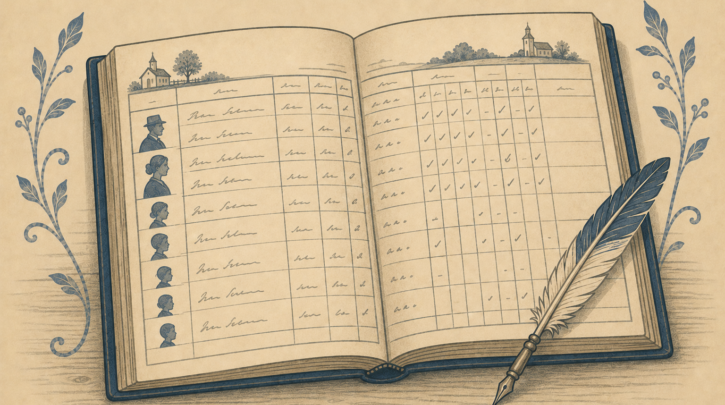
A household examination record is organised by farm or household within the parish, and for each person it can record a remarkable amount:
- Name, and often occupation or status within the household.
- Birth date and birthplace—frequently the exact date and the parish, which can point you to the next record to find.
- Moves—when a person moved into the household and from where, and when they moved out and to where.
- Marriage and death dates, and notes on these events.
- Catechism and reading knowledge—the original purpose, recorded in columns of marks.
- Notes—remarks on character, vaccination, communion, illegitimacy, poverty, and more.
Because the book is updated over a span of years and then continued in the next volume, you can follow a family from one volume to the next, watching children born, members move, and the household change—a continuous thread through time.
These books are free to read at Riksarkivet, and often clearest on ArkivDigital. Find both on the records hub.
How to use them in research
The power of the household examination records is that they tie everything together. A typical workflow is to locate your family in the book covering the right years, read off the birth dates and birthplaces, and then use the recorded moves to follow them backward and forward—a “moved in from parish X” note tells you exactly where to look next. The birth dates point you to the birth and baptism records for confirmation, and the chain continues. Used this way, the husförhörslängd is not just a record but a map of your family’s movements and generations.
A few cautions
The records are wonderful but demand care. The handwriting is old and takes practice to read; the columns and abbreviations follow conventions worth learning; and dates or places can contain errors, so confirm key facts against the event records. Because households are listed by farm, you also need to know roughly where in the parish your family lived, or to scan the volume. None of this is a serious obstacle—but the books reward patience and a methodical eye.
The joy of the husförhörslängd
Once you are comfortable with them, the household examination records become the backbone of your Swedish research and one of its great pleasures. Few experiences in genealogy match finding your family’s farm in a 200-year-old register and watching, line by line, as the generations live, marry, move and pass on. They are the reason Swedish ancestry can so often be traced with such richness and confidence—and the first thing to master once you have found your parish.
A worked example of following a family
To see why these records are so prized, imagine finding your great-great-grandfather as a boy in a household examination book covering 1820 to 1825. The entry gives his birth date and birthplace, lists his parents and siblings, and shows the family living on a named farm. The next volume, 1826 to 1831, carries them forward—a new child is born, an elder daughter moves out to another parish to work, the grandmother dies. Volume by volume, you watch the household change, and each birth date and each “moved from” note points you to the exact church-book entry or neighbouring parish to confirm and extend the line. No reconstruction from scattered certificates is needed; the family’s story is already gathered in one running record.
This continuity is the genealogical superpower of the husförhörslängd. In many countries you must assemble a family from separate birth, marriage and death certificates, hoping they connect; in Sweden, the household examination record presents the family as a living unit and tells you where its members came from and went. It turns the often-fragmentary work of genealogy into something closer to reading a family’s diary across the decades.
Tips for getting the most from them
A few habits help. Read the column headings, which identify birth data, moves, communion, reading knowledge and notes, even if the old hand takes practice. Note the farm or household your family lived on, since the books are organised by place and knowing it speeds every later search. Always carry forward the birth dates and birthplaces you find, as they are your pointers to the birth records and to earlier parishes. And cross-check anything crucial against the event registers, since the priest could err. With these habits, the household examination records become the reliable backbone of your whole research.