
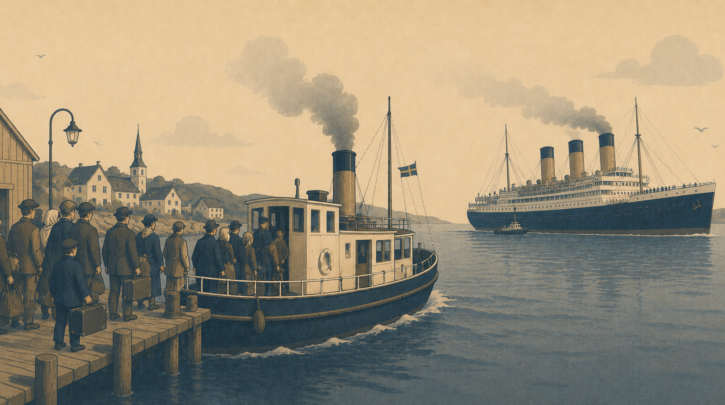

For the great majority of Swedish emigrants, the journey to America began at a single place: the harbour of Gothenburg (Göteborg) on Sweden’s west coast. Understanding the route they took from there—and, crucially, the records kept along the way—is both a window into your ancestor’s experience and one of the most valuable tools in tracing them. This guide follows the emigrant journey and explains the Gothenburg records that can lead you straight to the home parish.
Gothenburg: the gateway
Gothenburg was Sweden’s principal emigration port, and through it passed the bulk of those leaving for North America. Emigrants travelled to the city from across the country—by rail, road and boat—gathered in its emigrant quarters, and there bought or confirmed their tickets before sailing. For most Swedish-American families, the trail back to Sweden passes through Gothenburg, which makes the port and its records a natural focus of research.
Not sure where to start with your Swedish ancestry?
Get the Swedish Genealogy Quick-Start Checklist — a 5-step path to your first real ancestor record, plus the household examination rolls that make this research unusually detailed.
The indirect route via England
A point that surprises many descendants: most Swedish emigrants did not sail directly from Gothenburg to America. Instead they took an indirect route. A smaller steamer—famously those of the Wilson Line—carried them across the North Sea from Gothenburg to Hull in England; from Hull they travelled overland by train to Liverpool (or another west-coast port); and only there did they board the great transatlantic liner for New York or another American port. This means your ancestor may appear in English transit records as well as Swedish and American ones—a useful, often-overlooked source.
The Gothenburg records can name your ancestor’s home parish—the key to everything. Learn to use them in finding your Swedish emigrant ancestor, then dig into the records hub.
The Gothenburg police emigration records
Here is the genealogical gold. The Gothenburg police kept registers of emigrants departing through the port—the police emigration records (records of the city’s poliskammare)—and these are among the most valuable of all Swedish emigration sources. For each emigrant they typically recorded the name, age, home parish or last residence, destination, and date of departure. Because they name the home parish, these records can bridge the single most important gap in Swedish-American research: the link between the emigrant and the specific parish in Sweden. They have been indexed and compiled into databases that make searching them straightforward.
What the journey was like
The emigrant journey was arduous. After the overland trek to Gothenburg and the wait for passage, the North Sea crossing to Hull could be rough and crowded; the train across England and the wait at Liverpool added days; and the Atlantic crossing—though faster and safer by the later steamship era than in the early days of sail—still meant a week or more in steerage. Families travelled with what they could carry, often toward relatives who had gone before. Picturing this journey—weeks of travel toward an unknown land—restores the human reality behind the records and the courage your ancestors’ departure required.
From the port back to the parish
For research, the importance of the Gothenburg route is that it generated records at every stage—Swedish departure registers, the police emigration records, English transit records, and American arrival records—each a chance to confirm your ancestor and, above all, to recover the home parish. The port of Gothenburg is therefore not just where your family’s American story began, but where your research trail, followed backward, converges on the threshold of Sweden. From the parish those records name, the deep Swedish records take over.
Other ports and routes
While Gothenburg dominated, it was not the only way out of Sweden, and knowing the alternatives can help when an ancestor does not appear in the expected records. Some emigrants left through other Swedish ports, or travelled first to Copenhagen or to German ports such as Hamburg or Bremen and sailed from there. Others, especially from the north or east, took different routes entirely. A minority sailed on more direct services as these developed. If your ancestor is missing from the Gothenburg records, these alternative ports and routes—and their own passenger records—are worth considering, though for most families Gothenburg remains the first and best place to look.
The indirect route through England also means a whole layer of records exists between Sweden and America. British transit and passenger records, created as emigrants passed through Hull and Liverpool, can document an ancestor who seems to vanish between leaving Gothenburg and arriving in New York. These English records are an underused resource precisely because many descendants do not realise their Swedish ancestors passed through Britain at all—a direct consequence of the dominant indirect route.
Gothenburg today and the records’ legacy
For the modern descendant, Gothenburg holds a special place as the threshold their family crossed on the way out of Sweden, and the city remembers its emigrant history. More importantly for research, the meticulous records kept there—above all the police emigration registers—have been preserved, indexed and made searchable, turning a nineteenth-century bureaucratic routine into a priceless modern resource. That a clerk recorded your ancestor’s home parish as they passed through Gothenburg, and that the record survives and is searchable today, is the kind of fortunate documentary chain that makes Swedish-American genealogy so much more tractable than it might have been. From that recorded parish, the deep Swedish records open up.