
The obstacle that stops many people from tracing Swedish ancestry is the records themselves: old handwriting in an unfamiliar language. It is a smaller barrier than it looks. Swedish records are highly formulaic, so you are not really translating prose—you are recognising a fixed set of words in a predictable structure, and you need only a little Swedish to do it. Learn a few dozen terms and the shape of each record, and you can read the great majority of what you will meet. Here is how.
The handwriting
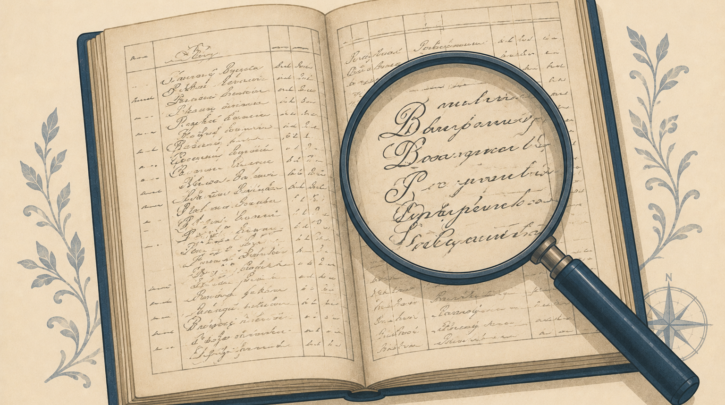
Older Swedish records—especially from the 1600s and 1700s—are written in an old style of handwriting that takes a little acclimatisation, including a German-influenced script in the oldest registers. The letters are formed differently from modern writing, and certain letters are easily confused at first. But the hand becomes familiar with practice, and crucially, because the records are formulaic, the context tells you what a word should be before you can fully read it: in a birth record, the word after the date is going to be a name, then the parents. Reading in context is the single most useful trick.
Not sure where to start with your Swedish ancestry?
Get the Swedish Genealogy Quick-Start Checklist — a 5-step path to your first real ancestor record, plus the household examination rolls that make this research unusually detailed.
Essential words
A small core vocabulary unlocks most records. Among the words you will meet constantly:
- född (born), döpt (baptised), dop (baptism).
- gift (married), vigsel (marriage), lysning (banns).
- död (died), begravd (buried), begravning (burial).
- son (son), dotter (daughter), hustru (wife), änka (widow), änkling (widower).
- inflyttad / utflyttad (moved in / moved out), socken / församling (parish).
The oldest records may use Latin terms—natus (born), baptizatus (baptised), mortuus (died), sepultus (buried)—so a handful of Latin words is worth knowing too.
Dates and numbers
Dates in Swedish records are mostly straightforward, but a couple of points catch people out. Numbers and months are worth learning in Swedish, and the very oldest records sometimes date events by the church calendar—naming a feast day or the Sunday in the liturgical year rather than giving a calendar date—which may require a conversion table. Most records you will use, however, give ordinary dates once you can read the handwriting.
Practice on real records—they’re free. Open your parish’s registers at Riksarkivet and read along; everything is on the records hub.
Building the skill
Reading old Swedish records is a skill that compounds quickly. A few habits accelerate it: read in context, letting the fixed format tell you what to expect; build a personal alphabet from letters you can read clearly; keep a glossary of the key Swedish and Latin terms; and compare the same name across several records to resolve ambiguous letters. Pair this with an understanding of Swedish naming—so you can anticipate patronymics and given names—and within an afternoon’s practice most people find they can read their family’s history in the original hand. The records are formulaic, the vocabulary small, and the reward—reading a 1750 baptism of your own ancestor—immense.
Working through your first record
The fastest way to learn is to decode one complete record slowly. Take a single birth-and-baptism entry from your parish on Riksarkivet, identify the fixed parts of the entry (which never change), and then isolate the handwritten details: the date, the child’s name, the parents’ names, the godparents. Look up any word you cannot place in a glossary of Swedish genealogical terms. By the time you have fully understood one entry, you will recognise the structure in every other entry of the same type, because they are all built on the same template—and the household examination and moving records follow their own equally consistent patterns.
Keep a personal cheat-sheet as you go—the event words, the months, the numbers, the relationship terms, and the way your particular priest forms tricky letters. Within a few records this becomes second nature, and the work shifts from laborious decoding to quick scanning for the names and dates you need. The handwriting that looked impenetrable at first becomes, with surprising speed, simply your ancestors’ handwriting, readable and even familiar.
Tools and help
Lean on the resources that exist. Printed and online glossaries of Swedish (and Latin) genealogical terms, word lists tailored to church and household examination records, handwriting guides for the old script, and feast-day conversion tables for the oldest dates all smooth the way. The active Swedish-genealogy community—through societies and online forums—is generous in helping decipher a stubborn entry, so a word or name that defeats you is rarely a true dead end. Combined with an understanding of Swedish naming, which lets you anticipate names before you read them, these aids turn the intimidating prospect of old Swedish handwriting into a skill you genuinely enjoy.