
Swedish immigrants did not scatter randomly across America; they concentrated, powerfully, in particular regions and communities—above all the upper Midwest. Knowing where Swedes settled is more than historical context: because emigrants from the same Swedish parish so often ended up in the same American place, the settlement patterns are a genuine research tool for tracing your family back across the ocean. This guide maps where the Swedes went and how that helps you.
The Swedish Midwest
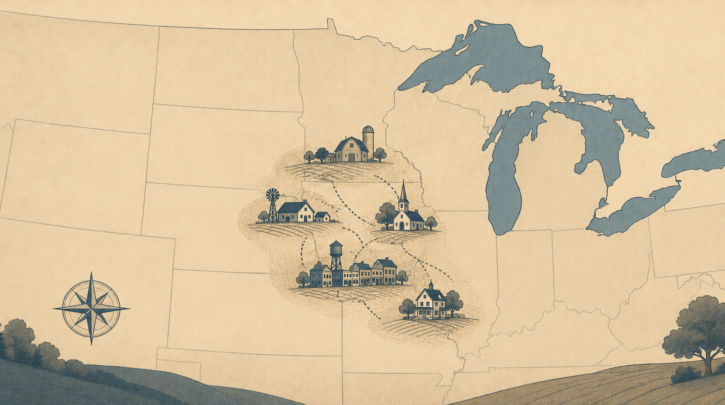
The heartland of Swedish America was the upper Midwest, where the landscape and the chance to farm recalled, and bettered, what many had left behind. The great centres were:
- Minnesota — the most Swedish of all the states, drawing huge numbers to its farmland and towns, and to the Twin Cities.
- Illinois — including a very large Swedish community in Chicago, one of the biggest concentrations of Swedes anywhere outside Sweden.
- Iowa, Wisconsin, Nebraska, Kansas and the Dakotas — rich farm country that drew Swedish agricultural settlers across the prairie.
Later movements carried Swedes farther afield—to the Pacific Northwest (Washington especially), to the east coast cities, and elsewhere—but the Midwestern farm belt and Chicago remained the core of Swedish America.
Not sure where to start with your Swedish ancestry?
Get the Swedish Genealogy Quick-Start Checklist — a 5-step path to your first real ancestor record, plus the household examination rolls that make this research unusually detailed.
Chain migration and parish clusters
The single most useful fact about Swedish settlement, for research, is that it was shaped by chain migration. The first emigrants from a parish wrote home, sent money and tickets, and drew relatives and neighbours after them—so people from one Swedish parish tended to cluster in one American community. A Swedish settlement in Minnesota might be full of families from the same few parishes in a particular Swedish province. This means that if you can identify where your ancestor’s neighbours and fellow congregants came from in Sweden, you have a strong clue to your own family’s parish.
Settlement clusters can point you to the parish. Combine this with the emigration records in finding your Swedish emigrant ancestor, and search on the records hub.
Early and notable settlements
A few settlements stand out in the story. Bishop Hill, Illinois, founded in the 1840s by a religious group, was one of the earliest organised Swedish colonies. (It should not be confused with the much earlier New Sweden colony on the Delaware River in the 1600s, a separate and far older chapter.) Across the Midwest, countless Swedish farming communities and town neighbourhoods—often centred on a Swedish church—grew up through the peak migration decades, each with its own ties back to particular corners of Sweden.
Using settlement patterns in research
To put this to work, study the community your immigrant ancestor settled in. Where did the other Swedes in that town or township come from? Which parishes recur in the local church records and among the families your ancestor married into or lived beside? Local and county histories, church anniversary books, and Swedish-American community records often reveal these origins. Because of chain migration, the answer for your ancestor’s neighbours is frequently the answer for your ancestor too—making the geography of Swedish America one more path back to the parish and the deep records waiting there.
Why Swedes chose the Midwest
The concentration of Swedes in the upper Midwest was no accident. The region’s climate and landscape echoed Sweden’s own, making its farming familiar; vast tracts of land were available cheaply or, under homestead provisions, almost free to those willing to work them; and the timing of the great migration coincided with the opening of these lands to settlement. For a Swedish farming family driven by land hunger, the Midwestern prairie offered precisely what they had been denied at home—a farm of their own—in a setting that felt, in its seasons and its soil, reassuringly like the country they had left.
Once the first Swedes established themselves in a district, chain migration did the rest, concentrating later arrivals in the same areas. This self-reinforcing clustering is why Swedish America has such distinct geographic centres rather than an even scatter, and why a county or township can be strongly Swedish in character to this day. Understanding the appeal of the Midwest helps you anticipate where a Swedish ancestor was likely to have gone, and the clustering it produced is what makes community-based research so effective for finding the parish.
Community records as a research resource
The concentrated nature of Swedish settlement created a wealth of community records that can illuminate your family. County and local histories, often compiled in the late nineteenth or early twentieth century, frequently include biographical sketches of settlers that name their Swedish origins. Church anniversary books, community newspapers, and the records of Swedish-American societies document the people of these settlements and their ties back to Sweden. Because your ancestor’s neighbours so often came from the same Swedish districts, these community sources—even when they do not mention your family by name—can reveal the cluster of parishes from which the whole settlement was drawn, pointing you toward your own family’s origin.