
To understand Swedish surnames at all, you must understand patronymics—the naming system that shaped the names of nearly all Swedes for most of history, and that lies behind the -son surnames so common today. It is a system both simple and, for the newcomer, confusing, because under it the surname was not fixed but changed with every generation. This article explains how patronymics worked, where they came from, and how they were ultimately frozen into the hereditary names of modern Sweden.
How the system worked
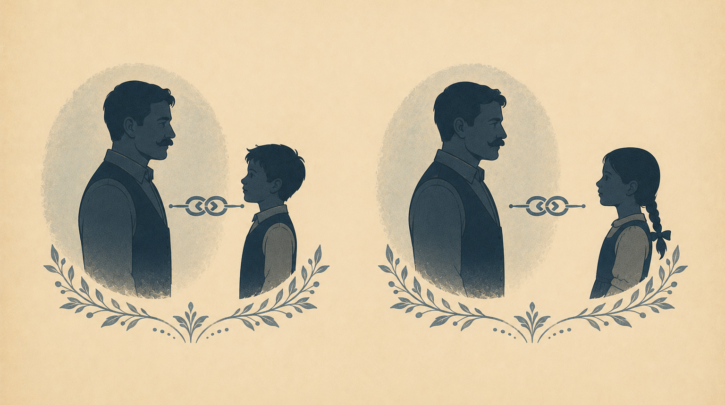
A patronymic is a name formed from the father’s given name. In Sweden the rule was straightforward: a son took his father’s given name plus -son, and a daughter took it plus -dotter (“daughter”). So the children of a man named Anders were Andersson (his son) and Andersdotter (his daughter). When that son, say Erik Andersson, had children of his own, they took his given name: Erik’s son was Per Eriksson, not Andersson. The surname thus shifted every generation, always naming the immediate father.
Not sure where to start with your Swedish ancestry?
Get the Swedish Genealogy Quick-Start Checklist — a 5-step path to your first real ancestor record, plus the household examination rolls that make this research unusually detailed.
Why it changed every generation
This is the feature that most surprises—and trips up—those new to Swedish genealogy. Because the patronymic always referred to the actual father, it was never a hereditary family name; it was regenerated afresh for each generation. A family line might run Sven → Anders Svensson → Erik Andersson → Per Eriksson, with a different “surname” at every step. As we explain in our guide to using Swedish naming in research, this means you cannot trace a Swedish family by following a surname—you must follow the chain of given names through parents and parish instead.
Women kept their own patronymics
A related feature, valuable for research, is that Swedish women retained their own -dotter patronymic throughout life and did not take their husband’s name on marriage. Maria Andersdotter remained Maria Andersdotter after marrying Erik Eriksson. For the genealogist this is a gift, because a woman can be followed by her own name across the records—a real aid to tracing maternal lines, and quite unlike the practice in many other countries.
Patronymics are the key to reading Swedish records—and the reason you trace by parish, not surname. See the research method in how to trace Swedish ancestry.
The freezing of patronymics: the 1901 Act
The patronymic system gave way under the Names Adoption Act of 1901, which required Swedes to hold a fixed, hereditary surname. Most families responded by freezing the patronymic they happened to bear at that moment—so a family then headed by an Anders became permanently Andersson, passing the name unchanged to all descendants thereafter. This single act converted a fluid, generation-by-generation system into the stock of fixed -son surnames Sweden carries today. The -dotter forms largely disappeared, as families adopted one hereditary name (usually the -son form) for everyone.
What this means for your name and your research
If your surname is a frozen patronymic—and for most Swedish descendants it is—two consequences follow. First, the name fixes the given name of an ancestor only around the time of freezing (about 1901, or whenever an emigrant family adopted a fixed name abroad), not a deep lineage. Second, to trace the family before the freeze, you must abandon the surname and follow the patronymic chain through the household examination records and church books, identifying each generation by its given names, parents and parish. Understood this way, the patronymic system is not a barrier but a logical, traceable pattern—and the foundation of nearly every Swedish family history.
Spelling and form variations
Patronymics show some variation worth knowing. The -son ending was sometimes written -sson (as in Andersson, with a doubled s where the father’s name ended in s) or contracted in older or dialectal records. The underlying given names also took different forms—Olof, Ola and Olle could all yield Olsson or Olofsson; Lars relates to Laurentius; Per, Petter and Peter interrelate. In the records you may meet a name spelled several ways across entries, so read flexibly and focus on the underlying father’s name rather than a single fixed spelling. This variability is normal and rarely an obstacle once you expect it.
The patronymic also sat alongside other name elements at times. A person might be recorded with a farm name before their given name in some regions, or take a soldier name on enlisting, while still “being” a patronymic Andersson underneath. Understanding the patronymic as the baseline—the name a person had by default as their father’s child—helps you make sense of these additional layers when they appear, and to recognise the same individual beneath the varying forms.
Patronymics across the emigration
For families who emigrated, the patronymic system met the new country’s expectation of fixed surnames, and the result shaped the American name. Many emigrants froze their patronymic on arrival or over time—independently of the 1901 Act back in Sweden—so a Swedish-American Anderson may date the fixing of the name to the moment of emigration rather than to Sweden’s law. This is why understanding patronymics matters even for descendants who never deal with the 1901 Act directly: the name they carry was almost certainly a fluid patronymic a few generations back, and tracing it into Sweden means following that patronymic chain through the records, generation by changing generation, back toward the parish of origin.