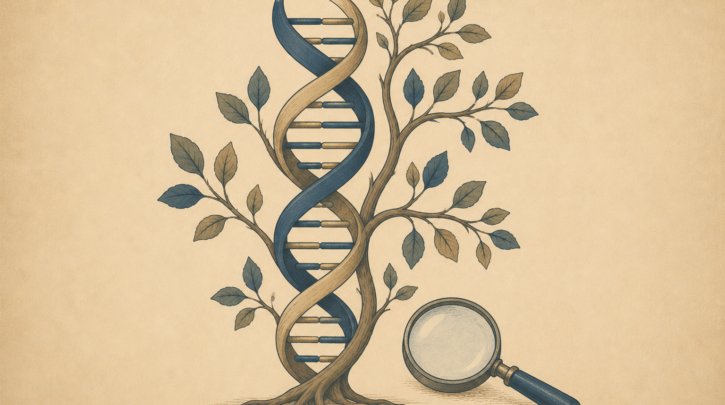

A DNA test can do two genuinely useful things for a Swedish family history: connect you with living relatives — sometimes cousins still in Sweden — and confirm the lines you have traced on paper. What it will not do is name your parish or build your family tree; for Swedish ancestry, the records do the building and DNA does the confirming. But not every test serves every goal equally well. This guide skips the generic spec sheet and instead matches each test to the specific problem it actually solves for Swedish research: a stubborn pre-1850 brick wall, finding cousins who never left Sweden, or working around household examination rolls that were lost, burned, or damaged.
Match your DNA test to your research goal
Skip the generic “which company is biggest” comparison. The right test depends entirely on what you are actually trying to accomplish. Here is how the major tests stack up against three problems Swedish researchers run into constantly.
| Your research goal | Best tool | Why it actually works | Where to start |
|---|---|---|---|
| Breaking through a pre-1850 emigration brick wall | FamilyTreeDNA (Y-DNA or mtDNA) | Autosomal tests fade out around 5–7 generations back. A single-line Y-DNA or mtDNA test reaches much further, and can cut through the confusion of shared patronymic surnames that autosomal matching cannot untangle once you are past a few generations. | Research a surname |
| Connecting with living cousins still in Sweden | MyHeritage | The most internationally diverse of the major databases, with meaningfully stronger representation across Europe and the Nordic countries than AncestryDNA’s US-heavy user base. | Swedish DNA hub |
| Filling gaps where husförhörslängder are missing or damaged | AncestryDNA + free triangulation tools | Sheer database size gives you the largest pool of candidate matches to work with when the paper trail runs out; GEDmatch and DNA Painter then let you confirm which candidate is real by mapping shared segments, without needing the record that no longer exists. | Connecting DNA to records |
Goal 1: breaking through a pre-1850 brick wall
A brick wall that sits before roughly 1850 usually is not a records problem in the way a later one might be — Swedish church records often survive well back into the 1700s, sometimes further. The problem is usually identity: dozens of unrelated men in the same province named Anders Andersson or Erik Eriksson, with no surname to tell them apart. Autosomal DNA, the type sold by AncestryDNA, MyHeritage, and 23andMe, reliably reaches back only about five to seven generations before the shared DNA from any single ancestor becomes too diluted to detect — often not far enough to settle which specific Anders Andersson is actually yours.
This is where FamilyTreeDNA earns its place. Its Y-DNA test follows the strict paternal line father to father to father, essentially unchanged for many more generations than autosomal DNA can track, because it is inherited as a single unbroken copy rather than a diluting 50/50 mix each generation. For a Swedish male-line brick wall, a Y-DNA test compared against a surname project can confirm or rule out a specific candidate ancestor even when the paper trail is genuinely gone or hopelessly ambiguous. The equivalent mtDNA test does the same job down the strict maternal line, though it is used less often because it cannot benefit from surname projects the way Y-DNA can.
This is not the test to buy first. It answers one narrow, specific question about one specific line, and it only works if the wall you are trying to break sits on a direct paternal (or maternal, for mtDNA) line. But for that specific situation, it does something autosomal DNA simply cannot.
Goal 2: connecting with living cousins still in Sweden
Finding a cousin who still lives in Sweden is a different problem entirely, and it is really a question of where the testers are, not which company has the cleverest matching algorithm. AncestryDNA’s database is the largest overall, but it skews heavily American, which is excellent for finding the diaspora side of your family and considerably less useful for finding the branch that stayed behind.
MyHeritage is the more international of the major platforms, with a meaningfully stronger user base across Europe, including the Nordic countries. For a researcher specifically hoping to connect with relatives who never emigrated, this tips the odds noticeably in MyHeritage’s favor. The practical strategy most researchers land on is to test once at AncestryDNA for its scale, then use MyHeritage’s free raw-DNA upload to add its Nordic-leaning match pool at no extra cost — giving you both databases from a single test kit.
Goal 3: filling gaps where husförhörslängder are missing or damaged
Not every parish’s household examination rolls survived intact. Fires, war damage in some border regions, and simple deterioration over centuries have left real gaps in the record for certain parishes and certain years — and when the household roll that would have confirmed a family relationship is gone, no amount of searching will produce a document that no longer exists.
DNA cannot recreate a burned record, but it can do something almost as useful: confirm a relationship independently of it. The practical approach combines two things. Start with AncestryDNA for the largest possible pool of candidate matches and its ThruLines feature, which proposes how a match might connect through a shared ancestor. Then take that hypothesis to GEDmatch and DNA Painter, both free, to check whether several matches share the same overlapping DNA segment and match each other — a triangulated group is strong evidence for a specific relationship even with no surviving document to point to.
This will not work for every gap, and it is genuinely more effort than reading a household roll would have been. But for a family reconstruction that would otherwise dead-end at a missing or damaged record, it is often the only path forward. See connecting DNA matches to Swedish records for the fuller method.
What an autosomal DNA test measures
AncestryDNA, MyHeritage, and 23andMe all sell the same type of test: an autosomal test, reading markers across the chromosomes you inherit from both parents. Because you receive roughly half of each parent’s DNA, the test reaches back reliably about five to seven generations — to your fourth or fifth great-grandparents. Beyond that, the DNA from any single ancestor becomes too small to detect. That reach is excellent for confirming relationships in the 1800s, the era your Swedish records cover richly, but it cannot by itself prove a connection to a distant ancestor of the 1700s — for that you need either the documents, or the single-line Y-DNA/mtDNA approach covered above.
AncestryDNA — the biggest database
AncestryDNA’s advantage is sheer scale, which matters most when your goal is finding relatives on the diaspora side — the descendants of the great migration across the American Midwest and beyond. For Swedish-American families especially, that pool is dense with relevant matches, and Ancestry’s tree integration and record hints are strong.
- Largest match database — the best odds of finding the cousin who has the photo, the story, or the name of the parish.
- Trees and hints — ThruLines suggests how matches connect through shared ancestors.
- Weak spot — no Y-DNA or mtDNA and no chromosome browser, so segment analysis must happen elsewhere.
MyHeritage — strong in Europe and the Nordic countries
MyHeritage deserves serious consideration for Swedish research because of where its users are. Its database is the most international of the major tests and is strong across Europe, including the Nordic countries — so it offers good odds of finding relatives who never left Sweden.
- European and Nordic reach — more testers in Sweden and nearby, improving the odds of finding cousins who stayed.
- Free uploads + chromosome browser — transfer your AncestryDNA results in, and gain a segment-analysis tool Ancestry lacks.
- Theory of Family Relativity — proposes how matches connect, useful as a lead but verify against records.
23andMe — health focus, and a cautionary tale
23andMe leads in health-and-trait reporting, but for Swedish genealogy it is usually the weakest of the four: no tree-building, no record integration, and a smaller matching database. You would choose it primarily for the health reports.
Worth knowing before you buy: 23andMe filed for Chapter 11 bankruptcy in 2025. After a contested auction, a nonprofit founded by its former CEO — the TTAM Research Institute — acquired its assets, and it now operates as a nonprofit. The episode drew lawsuits over genetic-data privacy, and legal scrutiny has continued. None of this makes your results wrong, but if the long-term custody of your genetic data matters to you, read the current privacy terms and know you can request deletion.
FamilyTreeDNA — for surname and lineage work
FamilyTreeDNA is the specialist. Alone among the four it offers Y-DNA testing, which follows the strict paternal line, and mtDNA, which follows the strict maternal line. As covered above, this is the tool for a genuinely deep brick wall — a question complicated in Sweden by the frozen patronymics shared by countless unrelated families — not a general first purchase.
Getting the most from whichever test you choose
Whatever kit you buy, a few habits separate a useful result from a frustrating one. Build at least a skeleton tree — four or five generations — before your results arrive, so the matching tools have something to work with; a test with no tree attached is a fraction as useful. Keep the tree public and on the same platform you test on, because that is what lets the hinting tools propose connections. And spend your time on the match list, not the ethnicity estimate — especially for Swedish results, where the ethnicity breakdown is an unusually blunt instrument that often cannot even separate Swedish from Norwegian or Danish.
Budget for patience, too. Results take a few weeks, the most useful cousins may not reply for months, and the real payoff accrues slowly as more relatives — including some still in Sweden — join the databases over the years. The major tests go on sale repeatedly through the year, so unless you are in a hurry there is rarely a reason to pay full price; because uploading a raw file to MyHeritage is free, the cheapest sensible strategy is usually to buy one kit on sale and transfer outward from there. We flag live discount windows on the DNA hub as they appear.
The honest bottom line
DNA is a powerful confirmation tool and a way to meet living cousins, but for Swedes it is the records that build and prove the tree — the free Riksarkivet registers and the church and household examination books can document a line DNA could only hint at. Test to find relatives and to verify; rely on the documents to know. And note one thing clearly: for citizenship, DNA carries no weight whatsoever — a point we return to in connecting DNA to your Swedish records.
Start with our Swedish DNA hub for kit links, then learn to fold results into a documented tree in connecting DNA to your Swedish records.