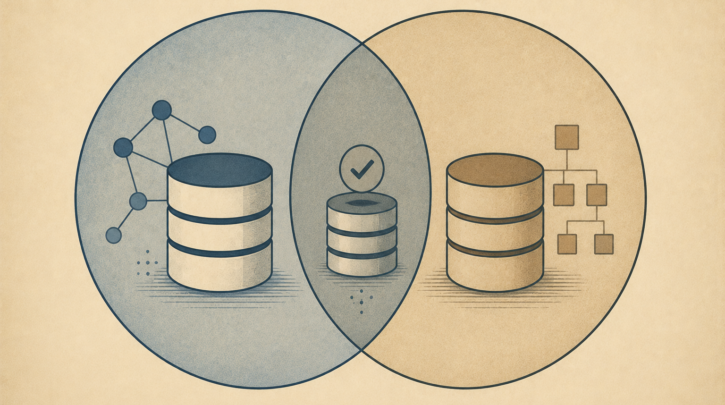

Here is a claim you will see repeated in genealogy forums until it starts to sound like fact: “Scandinavian DNA all looks the same, so it doesn’t matter which platform you test with.” It is a half-truth wearing a whole-truth’s confidence. The genetic similarity between Swedes, Norwegians, and Danes is real and well documented — but that is precisely why MyHeritage and AncestryDNA had to build very different systems to work around it, and those systems now perform very differently for a Swedish researcher. The platform matters. Just not for the reason most people assume.
Disclosure: this article contains affiliate links to MyHeritage. If you buy a DNA kit or start a trial through them, we may earn a commission at no extra cost to you. We do not earn commissions from AncestryDNA or the other companies mentioned. See our affiliate disclosure.
The kernel of truth in the myth
Start with what the myth gets right. As we cover in Swedish DNA ethnicity results, Sweden, Norway, and Denmark share so much recent population history — centuries of intermarriage, migration, and shared Nordic ancestry — that at the level of raw allele frequencies, a Swedish genome and a Norwegian genome really do look extremely similar. This is not a limitation of any one company’s algorithm; it reflects genuine population genetics. AncestryDNA’s own documentation is candid about this: some populations, in their words, “do not differ enough at a genetic level to be distinguished as separate regions.” Scandinavia is a textbook case.
What the myth gets wrong is the conclusion. Because this problem is well known, both companies have spent real engineering effort on workarounds — and they chose two genuinely different approaches, with different strengths for someone specifically trying to place an ancestor within Sweden.
How MyHeritage actually handles Swedish origins
MyHeritage took a different route, and pushed it further at the ethnicity-estimate level itself. Its newer Ethnicity Estimate v2.5 model was built specifically to improve on the old Scandinavia problem: MyHeritage has published before-and-after examples showing a user who previously received a flat “100% Scandinavian” result now getting a result that clearly splits Norwegian, Swedish, and Danish ethnicity into separate percentages, still summing to the same 100% Scandinavian total. That is a real, measurable improvement at exactly the level where the myth is truest.
MyHeritage also runs its own version of sub-regional placement, called Genetic Groups — over 2,100 geographic regions layered underneath its top-level ethnicities, including roughly 100 separate Swedish groups alone (and comparable numbers for Norway and Denmark), some resolving to a specific historic province, such as a “Southern Sweden” or a named landskap like Jämtland. Like Ancestry’s Genetic Communities, Genetic Groups are not derived from DNA in isolation — they are built by clustering genetically similar users who also share documented birthplaces, so they lean on the same genealogy-plus-genetics combination Ancestry uses, just packaged differently and, for Sweden specifically, with a more granular starting point.
MyHeritage also offers two optional extras. DNA Traits is a set of recreational reports on everyday characteristics, unlocked for a one-time fee per kit. DNA 360° is a separate kit that adds health and wellness reports to your ancestry results; it is for informational purposes only, is not a diagnostic test, and is currently sold only to adults in the United States and United Kingdom. Check MyHeritage for what is included (affiliate link).
DNA test
Ready to try a MyHeritage DNA test?
See what a MyHeritage DNA test includes, from ethnicity estimates to DNA matches with relatives who have tested too.
How AncestryDNA actually handles Swedish origins
At the headline “ethnicity estimate” level, AncestryDNA has historically not separated Sweden from Denmark at all — a documented example result reads simply “Sweden & Denmark,” as one combined region, with Norway typically folding into a similarly broad Scandinavian or neighboring grouping. If you are looking at the percentage breakdown alone, AncestryDNA genuinely does struggle to tell a Swedish ancestor from a Danish one, exactly as the myth describes.
Where AncestryDNA actually locates people within Sweden is a separate, less-discussed feature: Genetic Communities, recently rebranded as Ancestral Journeys. This is not an ethnicity calculation at all — it is a network analysis. Ancestry looks at clusters of members who match each other more than they match anyone else, cross-references their public family trees and historical records, and identifies where that whole cluster likely lived, sometimes down to a specific county or city, for the period roughly 1700–1975. In principle, this can place a Swedish ancestor with real precision — but only if enough other AncestryDNA members with documented trees from that same Swedish community have also tested and linked their trees. In practice, that depends entirely on database depth for that specific parish, not on anything read directly from your DNA.
Side by side: the actual mechanisms
| What you’re comparing | MyHeritage | AncestryDNA |
|---|---|---|
| Top-line ethnicity percentage | Ethnicity Estimate v2.5 splits Norwegian, Swedish, and Danish into distinct percentages | Often blends Sweden & Denmark into one region; weak country-level separation |
| Sub-regional placement within Sweden | Genetic Groups — roughly 100 Swedish groups, some resolving to a specific historic province | Genetic Communities / Ancestral Journeys — network clustering of matches + trees, county/city-level for 1700–1975 |
| What actually drives the precision | Depends on how many genetically similar users share a documented birthplace in that group | Depends on how many matched members have documented Swedish trees linked in that specific area |
| Access | Some match-comparison views require a paid MyHeritage plan (Complete, Premium, or PremiumPlus) | Included with a standard AncestryDNA kit |
Where both platforms still struggle
Being fair to the myth: neither system is magic, and both hit real limits specifically within Sweden.
- Both approaches are genealogy-assisted, not purely genetic — they work by finding other users who already have a documented birthplace, not by reading a location directly off your DNA. If your ancestral parish is thin in either company’s database, you may get a vague regional placement, or none at all, even though the underlying genetic signal is perfectly real.
- Sweden’s internal population history — centuries of internal migration between provinces, especially as industrialization pulled people toward cities — means even a strong Genetic Group or Community can reflect where a cluster of documented ancestors happened to settle, not necessarily the single ancestral parish you are trying to confirm through documented records.
- Neither company’s sub-regional feature should be treated as proof of a specific parish. Both are genuinely useful leads — a reason to go looking in a particular province’s records — not a replacement for finding the ancestor in the records themselves.
So does the platform matter? Yes — just not how you’d guess
The platform absolutely matters for a Swedish researcher, but the reason has nothing to do with Swedish DNA “looking different” from Norwegian or Danish DNA at some deep biological level it doesn’t. It matters because MyHeritage and AncestryDNA built two different technical workarounds for the same shared limitation, and those workarounds have different strengths: MyHeritage’s newer model is currently ahead on cleanly separating Sweden from its Nordic neighbors at the percentage level, and its Genetic Groups start from a more granular Swedish baseline. AncestryDNA’s Genetic Communities can be equally or more precise for a specific family, but only where its much larger overall database happens to be deep in exactly the right Swedish community — which, for diaspora-heavy areas connected to the great migration, it very often is.
The practical recommendation
Given all of that, the dual-testing strategy remains the right call for most Swedish researchers, for reasons that go beyond ethnicity precision alone.
- Test with MyHeritage first if your relatives are more likely to be in Sweden or elsewhere in Europe, for its Nordic-leaning match pool and its currently more precise Scandinavian ethnicity split; test at AncestryDNA first if they are mostly in the Swedish-American diaspora, for its larger overall match database.
- To add the other pool you need a second test: MyHeritage stopped accepting DNA uploads from other companies in August 2025, and AncestryDNA has never accepted them. Your AncestryDNA file can still be uploaded free to FamilyTreeDNA and GEDmatch.
- Treat both platforms’ sub-regional placements — Genetic Communities and Genetic Groups alike — as leads to chase in the actual records, never as a final answer on their own.
- For matches and hints, compare notes across both: a lead corroborated on both AncestryDNA and MyHeritage is considerably more trustworthy than one appearing on just one platform.
Both kits, current prices, and the setup walkthrough are on our Swedish DNA hub. Already have matches or a Genetic Group pointing somewhere specific? Anchor it to real evidence in connecting DNA to Swedish records.
Free trial
Ready to put your research into a family tree?
Start a free MyHeritage trial to build your tree online and search historical records and other family trees as you add each generation.
Privacy and your data
Both companies let you delete your data and download your raw file, and both have had to reckon publicly with how genetic data is stored and shared. Before you test, read the current privacy settings on whichever platform you choose, decide whether to opt in or out of research uses, and keep a copy of your raw data file somewhere safe so you are never locked into one company. The wider industry — most visibly the upheaval at 23andMe — has given everyone reason to take genetic-data privacy seriously, and a little attention to the settings now saves worry later.
The honest bottom line
Scandinavian DNA being genetically similar is real. “So the platform doesn’t matter” does not follow from it — if anything, the opposite is true, because it is exactly this similarity that pushed MyHeritage and AncestryDNA to build two different systems, with two different sets of strengths, to solve the same problem. Test with an understanding of which system you are actually relying on, treat every sub-regional placement as a lead rather than a verdict, and let the documented records make the final call.