
You took a DNA test expecting to see “Swedish,” and instead your results say Scandinavian—perhaps lumping Sweden together with Norway and Denmark, with no clean Swedish slice at all. This is normal, and it reflects a real feature of Scandinavian populations: they are closely related and genetically hard to tell apart. Understanding why helps you read your results sensibly and avoid the common misconceptions. This guide explains what Swedish DNA results really mean.
Why ‘Swedish’ shows up as ‘Scandinavian’
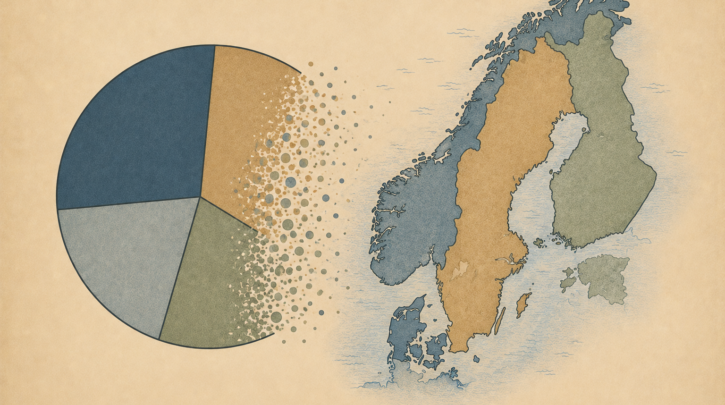
The peoples of Sweden, Norway and Denmark have lived side by side, intermarried and shared ancestry for a very long time, and as a result they are genetically very similar. The DNA testing companies estimate ethnicity by comparing your DNA to reference populations, and because the Scandinavian populations overlap so heavily, the companies often cannot cleanly distinguish Swedish from Norwegian or Danish ancestry. So a thoroughly Swedish family commonly receives a broad “Scandinavian” result rather than a precise “Swedish” one. This does not mean your test is wrong or that you are “not really Swedish”; it means Swedish ancestry does not have a sharply distinct genetic signature separable from its neighbours.
Not sure where to start with your Swedish ancestry?
Get the Swedish Genealogy Quick-Start Checklist — a 5-step path to your first real ancestor record, plus the household examination rolls that make this research unusually detailed.
Regional estimates are improving—slowly
The companies do try to offer finer breakdowns, and these have improved over time, sometimes suggesting a more specific Nordic region or even a sub-region. But for Scandinavia the resolution remains limited, and the estimates shift with every update to the companies’ methods and reference panels. Treat any sub-regional Swedish estimate as an interesting, evolving guess rather than a fixed fact—and certainly not as a substitute for documentary evidence of where your family actually lived.
Sweden is largely outbred
One piece of good news for Swedish researchers concerns endogamy—the marrying within a closed community over generations that, in some populations, inflates the number of DNA matches and makes relationships look closer than they are. Sweden, broadly, is not strongly endogamous: the population mixed and moved enough that matches generally behave predictably, without the heavy inflation seen in some other groups. This makes Swedish DNA matching relatively straightforward to interpret compared with, say, populations that married within a small community for centuries.
One honest exception: certain historically isolated communities—parts of the far north, some remote rural or island areas, and the Sami populations, who have their own distinct ancestry—can show more intermarriage and their own genetic patterns. If your roots are in such an area, your matches may behave a little differently, and the Sami in particular carry ancestry distinguishable from the general Scandinavian background. For most Swedish families, though, the outbred pattern holds.
Your matches—not your ethnicity pie chart—are where the genealogy lives. Learn to use them in finding Swedish relatives with DNA, and choose a test on the DNA hub.
What ethnicity estimates cannot do
The single most important thing to remember is that an ethnicity estimate cannot name your parish, your province, or even reliably distinguish Sweden from its neighbours. For Swedish ancestry, where the signal is a broad Scandinavian blend, this is especially true: the percentages confirm a general Nordic origin you likely already suspected, but they cannot point to the parish—and only the records and your matches can do that. Enjoy the broad-strokes story your DNA tells about your Scandinavian roots, but build your genealogy on the documents, which in Sweden are rich enough to carry you back centuries.
Reading a Scandinavian result sensibly
When your results come back as broad “Scandinavian,” hold the breakdown loosely. The companies estimate these percentages by comparing your DNA to reference panels, and because the Swedish, Norwegian and Danish populations overlap so heavily, the split between them is genuinely fuzzy and shifts with every update to the methodology. A thoroughly Swedish family might see their ancestry labelled simply Scandinavian, or split in proportions that change overnight without a single new fact entering their tree. That alone tells you how much genealogical weight to place on the ethnicity split: very little. It confirms a Nordic origin you likely already knew, and not much more.
Used wisely, though, the estimate can still interest you. It situates your family in the deep history of the Nordic region, and where a result hints at non-Scandinavian elements—a little Finnish, German, British or other ancestry—that can occasionally flag a genuine line worth investigating in the records. Enjoy the broad story the estimate tells about your Scandinavian roots, while keeping the genealogy itself firmly grounded in documents, which are the only thing that can identify a province, a parish, or a specific ancestor.
The deep-history angle
Swedish DNA results reward a little curiosity about deep history. The Scandinavian populations carry a shared northern European ancestry shaped over thousands of years, and ongoing research continues to refine the picture of how Sweden was peopled and how its regions differ. The distinct ancestry of the Sami in the north is a particularly interesting strand, genetically separable from the general Scandinavian background. For the family historian this is rich context rather than practical genealogy—it will not name your parish—but it adds meaning to a result that might otherwise look disappointingly like a single undifferentiated “Scandinavian” block, and it is a reminder that your ancestry is part of a long and fascinating northern story.