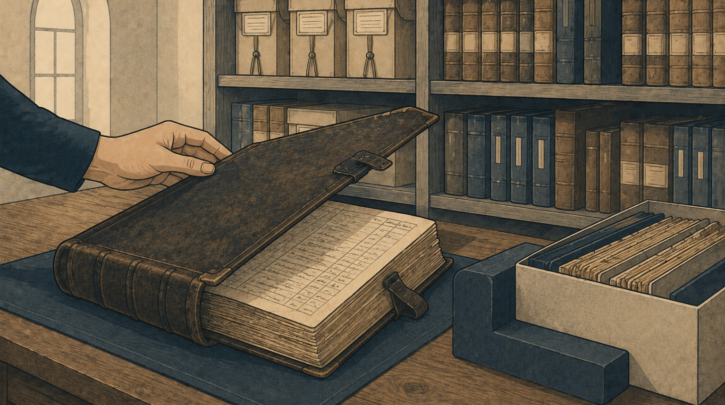

For the dedicated family historian on a heritage trip, the idea of researching in Swedish archives in person has real romance—holding the original register, walking into the archive where your family’s records are kept. With Sweden, though, there is an honest twist worth knowing up front: because so much is already digitised and free online, in-person research is often more about experience and the occasional un-digitised record than about necessity. This guide explains when and how to do it, and how to set your expectations.
First, the honest truth: much is already online
Sweden is one of the most thoroughly digitised countries in the world for genealogy. The free Riksarkivet, the paid ArkivDigital, and FamilySearch together put an enormous share of the church and household examination records at your fingertips from anywhere in the world. For most families, the core records you need can be read online without ever entering an archive. This is wonderful news—and it means you should not assume you must travel to an archive to break a wall; very often the record is already on your screen.
Not sure where to start with your Swedish ancestry?
Get the Swedish Genealogy Quick-Start Checklist — a 5-step path to your first real ancestor record, plus the household examination rolls that make this research unusually detailed.
When in-person research helps
That said, on-site research still has its place, and a few situations genuinely call for it:
- Un-digitised local records — some local, estate, organisational or more recent records may not be online and survive only in a regional archive or locally.
- Deeper or specialised sources — estate inventories, court and tax records, and other materials beyond the church books, for research that has gone past what is digitised.
- The experience itself — for many, seeing the original volumes and the places where they were kept is a meaningful part of the journey, even when the same pages are online.
Where the records are kept
Sweden’s archives are well organised. The National Archives (Riksarkivet) holds national records and, through its regional branches (the former landsarkiv, in cities such as Lund, Vadstena, Uppsala, Gothenburg, Härnösand, Östersund and Visby), the regional and parish records of each area. Older church records were generally transferred from the parishes to these regional archives for preservation, though some local material may remain with the parish or a local heritage association. Knowing which regional archive covers your parish tells you where any un-digitised originals are likely to be.
Archives have their own opening hours, rules and procedures, and may require you to request materials in advance or to use digitised versions in the reading room even for held originals. If you plan an in-person visit, contact the archive ahead, confirm what is available on-site versus online, and check requirements—so you do not travel for a record you could have read at home.
Before planning any archive visit, check whether the record is already online—most are. Start at the free Riksarkivet via the records hub, and weave any real archive visit into your wider heritage trip.
Making the most of an archive visit
If you do visit an archive, prepare as you would for any research: know exactly what you are looking for, bring your traced line and the gaps you hope to fill, and confirm in advance that the material is held there and not simply online. Swedish archivists are professional and helpful, and many speak English, but their time is best used on the specific, un-digitised records only the archive holds. Approached this way—with the digitised work done first and the visit focused on what truly requires being there—in-person research becomes a rewarding complement to your online work and your parish visit, rather than a duplicated effort. In Sweden, the archive visit is often the icing; the free online records are the cake.
Why the digitization changes the calculus
It is worth dwelling on how unusual Sweden’s situation is, because it genuinely changes how you should plan. In many countries, an ancestor’s records exist only on paper in a distant archive, so an in-person visit—or a hired local researcher—is often the only way to obtain them, and a heritage trip doubles as a vital research expedition. In Sweden, by contrast, the core church and household examination records are overwhelmingly online and free or low-cost, so the same research can usually be done from your living room. This is liberating: it means your heritage trip can focus on experience and connection—the parish, the relatives, the landscape—rather than on frantic archive work, because the documents are already in hand.
This does not make the archives irrelevant, but it reframes them. The reason to visit an archive in Sweden is usually either to see something genuinely not digitised—a particular local or specialised record—or for the meaning of holding the originals and standing where they are kept. Both are legitimate, but neither is the desperate necessity it can be elsewhere. Knowing this spares you from building a trip around archive visits you do not need, and frees you to spend your limited days on the parish and the people, which is what most descendants most want anyway.
Hiring help, if you need it
If you do hit a wall that requires un-digitised records and cannot travel, or if old handwriting defeats you, a professional researcher experienced in Swedish records can help—retrieving records from a regional archive, reading difficult hands, or pursuing the more specialised sources beyond the church books. Sweden’s active genealogical community and societies can also point you to resources and, sometimes, volunteers. But for most families, the combination of the free online records, a little skill at reading them, and a heritage trip focused on experience rather than archive-digging is all that is needed—a happy situation that Sweden’s remarkable commitment to digitisation has made possible, and one more reason Swedish ancestry is such a rewarding thing to trace.