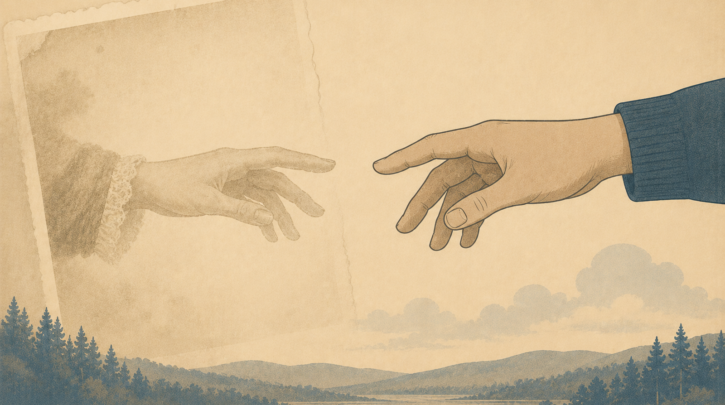

For many people—especially the descendants of emigrants whose families set aside the language and the old ways a generation or two ago—genealogy is the beginning of something larger. Tracing the tree answers who your ancestors were; reclaiming your heritage is about carrying something of what they were into your own life. This is a guide to that fuller journey: from records to language, food, traditions, living connection—and the freeing truth that none of it requires a passport.
Start with the records—but don’t stop there
The foundation is knowing your family. Trace your line as far as Sweden’s deep records allow, using the free Riksarkivet, the church books and the household examination records, and the methods in our guide to tracing Swedish ancestry. But a tree on a screen is not yet a reclaimed heritage—the names become meaningful when you learn what their lives were like, the world of the great migration or the province they came from.
Not sure where to start with your Swedish ancestry?
Get the Swedish Genealogy Quick-Start Checklist — a 5-step path to your first real ancestor record, plus the household examination rolls that make this research unusually detailed.
Reclaim the language
Few things reconnect you to a heritage like its language, and here Swedish descendants have it easier than many. Swedish is, for English speakers, one of the more approachable languages—a Germanic relative of English, with familiar structures and abundant learning resources. For families who lost it in the push to assimilate, learning even a little Swedish can be deeply moving: the recovery of an ancestral voice, and the key to reading your family’s records in the original. You need not aim for fluency; even a foothold connects you to the culture and the documents in a new way.
A note for those who arrived here hoping for a passport: as our honest citizenship guide explains, most descendants of Swedish emigrants do not qualify for Swedish citizenship, and—unlike some countries—learning the language confers no citizenship benefit. But that does not diminish the language as heritage. You learn Swedish here not for a document, but for the connection itself, which is reason enough.
Reclaim the traditions
Heritage lives in practice as much as in study, and Swedish traditions are among the most joyful in the world to take up:
- Midsummer (Midsommar) — the great Swedish festival, with its flower-decked maypole, flower crowns, dancing and feasting at the height of the long summer light; perhaps the heart of Swedish culture.
- Lucia — the candlelit procession of 13 December, with white robes, songs and saffron buns, a beacon in the dark of winter.
- The table — meatballs and lingonberry, pickled herring, crispbread, cinnamon buns and the daily ritual of fika; the crayfish parties of late summer; the Christmas julbord.
- Folk culture — the music, dances and provincial folk costumes, and the deep Swedish love of nature and the right to roam.
Reclaim the connections
Heritage is also people. A DNA test can put you in touch with living cousins—in Sweden, the Americas, and beyond—who share your ancestors and often your enthusiasm; and because Swedes test at a high rate, relatives in the old country are genuinely findable. Reconnecting with family who never left the ancestral parish is one of the most powerful forms of reclamation there is, and nothing roots heritage more firmly than standing together where your shared ancestors lived—which is why so many people pair the search for relatives with a heritage trip.
Find the living branches of your family: choose a test on the DNA hub and learn to turn matches into real connections with our matching guide.
Heritage without a passport
It is worth saying plainly, as a kind of liberation. The honest reality is that most descendants of Swedish emigrants cannot claim Swedish citizenship—but your heritage does not depend on a passport, an application, or anyone’s permission. The records that reach back to the 1600s, the cousins to find, the parish to visit, the language, the food, the Midsummer pole—all of these are yours, fully and freely, citizenship or no citizenship. Where the citizenship answer is usually no, the heritage answer, for everyone with Swedish roots, is an unqualified yes. That is the better inheritance, and it asks nothing of you but curiosity.
A heritage worth the effort
To reclaim a Swedish heritage is to take up something that was, for many families, set aside—a language dropped to fit in, a provincial identity flattened into a generic label, a parish forgotten across an ocean. Picking it back up, in whatever measure suits your life, is a quietly radical act of continuity: you become a link that holds rather than one that breaks. Begin with the records, because they are extraordinary and they are yours. Then let them lead you outward—to the language, the table, the traditions, the province, the cousins, the parish itself—until the heritage is not just something you have researched, but something you live.
Wherever you are on the journey, start where it’s richest: trace your line with the research guide and the free records, then carry it into the world—a trip to the parish or a search for living cousins.
Heritage at your own pace
It is worth saying plainly: reclaiming a heritage is not a test you pass or fail, and there is no single correct amount. Some people will learn Swedish, travel to the ancestral parish, and keep Midsummer every year; others will cook meatballs at family gatherings, learn a handful of Swedish words, and feel entirely, rightly connected. Both are reclamation. The point is not to perform an identity to anyone else’s standard but to let your ancestry become a living part of your own life in whatever measure fits—and to know that even the smallest steps are real and worthwhile.
This matters especially for those who feel they have “lost too much” to begin—descendants whose grandparents stopped speaking Swedish, whose name was anglicised, who grew up with little sense of the heritage at all. None of that disqualifies you. The records are still there, free and deep; the cousins are still there, in Sweden and across the diaspora; the traditions are still there; and the door is open at whatever point you choose to walk through it. A heritage interrupted in one generation can be taken up again in the next.
Passing it on
The deepest form of reclamation is transmission—making sure what you have recovered does not stop with you. Share the documented tree with your children and cousins; keep Midsummer or Lucia with the next generation and tell them whose traditions they are; cook the dishes and name the ancestors whose recipes they were; bring a young relative on the heritage trip; if you learned some Swedish, pass on a few words; write down the family stories before they are lost again. A family history is only as alive as its newest keeper. By becoming that keeper—and then handing the role onward—you turn a personal project of discovery into something that will outlast you, which is, in a sense, exactly what your ancestors did when they carried their family and their hopes across the ocean in the great migration, and what every generation that holds onto its heritage does in turn.